The Achaemenid army was the fighting force of the first Persian empire, under Darius I and his successors: the seasonal levy of the subject nations set beside the standing royal guard the Greeks called the Immortals; the shield-and-bow files, the bow as the national weapon, the cavalry and the scythed chariot; the great ethnic army-list of Herodotus and the modern case against its millions; supply, pay and the navy; fortification and siege; and, throughout, the gap between the Greek image of a vast, soft oriental horde and the professional reality the documents disclose.
The army was the instrument by which a petty kingdom of Persis became, within a generation, the largest empire the world had yet seen, and by which it was held for two centuries. Yet it is oddly hard to see. The kings' own inscriptions almost never describe their forces; the administrative tablets record soldiers only as men drawing rations or holding land; and the fullest narratives, the ones every schoolbook draws on, are Greek, written by the enemy, and shaped by a literary image of the barbarian host that has proven very difficult to see past. The received picture has therefore to be set beside the documentary and archaeological evidence, and the specialist scholarship, above all Sean Manning's Armed Force in the Teispid-Achaemenid Empire (2021), is cautious about what the Greek tradition really establishes.[1]
The composition: the levy and the standing guard
An Achaemenid army was two things joined together. At its heart was a small standing force of professional soldiers, kept under arms the year round; around that gathered, when a great campaign required it, a seasonal levy drawn from the subject nations of the empire. The standing core answered to the King of Kings as commander-in-chief, a constant across the whole dynasty even when the king delegated a campaign to a general; the levy was raised through the satraps, each of whom held forces in his province, subject to an annual royal review of their arms and horses, and could be called to bring his contingent to the muster.[2] The satrapal armies could combine into a powerful temporary coalition, as they did to face Alexander at the Granicus; above the satraps, in the later empire, a regional marshal the Greeks called the kāranos might hold command over several provinces at once.
The organisation of the standing army was decimal, and the philologists have recovered its ladder of command from Old Persian words surviving in Greek, Elamite and Akkadian: a file of ten under a daθapati, a hundred, a thousand under a hazārapati (the "commander of a thousand" whom Greek sources remember), and a corps of ten thousand. Herodotus describes exactly this structure, regiments of ten thousand broken into thousands, hundreds and tens, and the survival of the word hazārapati in independent sources supports him.[3] The upper rungs are less secure than the lower, though: no ancient text attests the reconstructed word for a corps of ten thousand or its commander, and the top of the tidy decimal ladder is a modern completion.[1] Command ran up from this frame to the king, who led the greatest expeditions in person. One office shows how far the army and the court interpenetrated: the chiliarch, the hazārapati just met, captained the royal bodyguard and at the same time controlled access to the king through the protocol of the audience, so that the captain of the household troops was also one of the great officers of state.[2]
The most famous single body was that standing corps of ten thousand elite Iranian foot whom Herodotus calls the Immortals, a Greek name a widely represented view takes to mistranslate an Old Persian original rather than any word for "immortal"; that reading is itself a contested modern conjecture, and the whole question of the guard's name, number and image has its own account (see the Immortals).[3]
Beyond this professional heart, the mass of an imperial army was a levy. Every Persian male, on the reconstruction drawn from Strabo and Xenophon, owed service, and men held estates in return for the obligation to muster armed and equipped, most clearly documented in the ḫaṭru land-for-service system of Achaemenid Babylonia, where a plot of "bow land" or "horse land" carried the duty to send a bowman or a cavalryman when the crown called.[4] To gather such a host from across a continent took a long time, sometimes years; this is one reason the empire kept garrisons at its strategic nodes, the best-documented being the Jewish and Aramean soldiers of the frontier garrison at Elephantine in Egypt, organised in detachments and serving the crown directly.
What the documents disclose, and the Greek narratives obscure, is that this was an administered army rather than a horde summoned by a war-cry. The Persepolis tablets record soldiers as men on ration-rolls, drawing measured allowances of flour, wine and animals; the Babylonian contracts set out the fief-holder's obligations in writing; the Aramaic papyri show garrison detachments paid, provisioned and mustered by the crown. The size of a levy was therefore governed less by how many men the empire held, which was vast, than by how many it could feed, move and pay along a single line of march, and by how long it could keep them together before the season and the supply corridor forced them home. That constraint is the frame within which the ancient figures have to be judged, and it is why the modern reckonings of army size work forward from ration-quantities and road-capacities rather than backward from Herodotus' totals.[4][1]
The shield-bearers, the bow and the spear
The distinctive Persian infantry formation set a front rank of large shields before files of archers. The shield, the gerron of the Greek texts, was a light thing of sticks threaded through a wet sheet of leather, tough enough to stop an arrow and carrying no metal; the big rectangular type could be planted in the ground to make a standing wall from behind which the bowmen shot. The shield-bearer is caught in an Old Persian word surviving only in a Greek gloss, reconstructed as *spara-bara, and it has become convenient, if not strictly warranted by the evidence, to call this Herodotean Persian infantry sparabarai.[1] Farrokh reconstructs the file as ten shield-bearers in front of nine rows of infantry-archers, the shieldmen themselves carrying a spear for the moment the enemy closed.[5]
The bow was the national weapon, the arm a Persian boy was reared to and the sign of the king himself, who holds it on his tomb relief and on the daric. The composite bow, of horn and wood and sinew, was a short weapon with a long weapon's power. Beside it the Persian carried the akinakes, the short double-edged dagger-sword worn at the thigh in the "Median" riding costume, and, above all, the spear. Darius set the two weapons at the centre of the ideal he cut on his tomb:
As a horseman I am a good horseman. As a bowman I am a good bowman, both on foot and on horseback. As a spearman I am a good spearman, both on foot and on horseback.
Darius I, DNb §2h, trans. Kuhrt[6]
The importance of the spear is easy to underrate, because Greek writing was at pains to cast the Persian as the archer and the free Greek as the spearman. Yet at Naqsh-e Rostam Darius bids the viewer read the reach of Persian arms in the very peoples who bear up his throne:
If now you should think: 'How many are the countries which King Darius held?', look at the sculptures (of those) who bear the throne, then shall you know, then shall it become known to you: the spear of the Persian man has gone forth far; then shall it become known to you: the Persian man has delivered battle far indeed from Persia.
Darius I, DNa §4, trans. Kuhrt[6]
On the reliefs of Persepolis, too, there are more spears than bows. Herodotus' claim (7.61, 7.211) that Persian spears were markedly shorter than Greek ones, endlessly repeated by modern narrators, is not supported by the art, in which Persian and Greek spears alike range from roughly the wielder's own height to a third as long again; Manning shows the "short spear" to be a rhetorical cliché, embedded by Herodotus in a discourse about soft eastern and hard western manhood, and argues there is no basis for calling the other Persian weapons inferior either.[1] The body armour was scale, of bronze or iron, "like the scales of a fish" in Herodotus' phrase, though he himself implies otherwise: his own division of the Persians after the Salamis campaign, into Immortals, cuirass-wearers and the rest, marks armour out as the badge of some soldiers only, just as in a Greek army.[1]

Guards in alternating Persian and Median dress on the northern stairway of the Apadana at Persepolis, carved about 515 BCE. Spears, bows and short swords are visible, but the ordered court relief is a representation of royal service, not a battlefield formation. Aneta Ribarska · via Wikimedia Commons · CC BY-SA 3.0 source ↗
Set together, these arms describe a system rather than a collection of weapons. A Persian battle opened at a distance, with massed archery and the harassing sweep of light horse, and closed with the spear and the standing shield-wall; the design was to break an enemy's cohesion before contact and to win on open ground, where missiles and cavalry could work. Against the empire's usual opponents it succeeded for generations. Its limits showed only where the ground was closed and the enemy would neither scatter under arrows nor be turned by horse, but came on in close order behind longer spears and heavier armour, at the narrow pass and in the hoplite line. The Greek tradition read those particular reverses back into the whole, and made a mismatch of tactical systems on unfavourable ground into a verdict on Persian courage.[1]
The horse and the scythed chariot
Cavalry was the arm of the nobility and of the northern and eastern Iranians, the Saka above all, who fought as mounted bowmen. The horseman of Media wore the trouser-and-tunic riding suit, carried the bow, the akinakes and a pair of javelins or a thrusting spear (the Greeks' palton), and rode the fine Nisaean horses without stirrup or true saddle, holding his seat by the grip of his knees. The best mounts came from the Nesaean plain of Media, celebrated for its exceptionally large horses, and the pasture-lands of Media and Armenia supplied the royal studs on a scale the sources make plain: the satrapy of Armenia is said to have rendered up twenty thousand foals a year for the festival of Mithra.[4] Manning devotes careful attention to the special economics of cavalry: a good horse was ruinously expensive and a fragile asset, and the arrangements by which a would-be cavalryman borrowed or was compensated for his mount have close parallels in societies whose cavalry no one calls decadent, from the loan (katastasis) the city of Athens made its horsemen to the horse-troubles of British officers at Waterloo.[1]
The scythed chariot is a special case, and a cautionary one. In the modern imagination it is a signature Persian weapon; in the evidence it is, in Manning's phrase, "essentially a creature" of Greek and Latin literature. No depiction of one survives from any place and time where they were actually used; the weapon first appears in Ctesias' tales of the legendary King Ninus and in Xenophon, and thereafter becomes a fixed symbol of the exotic, fumbling armies of the East, prominent in the stories of Gaugamela and later of Mithridates, retold with growing relish by writers who had never seen a phalanx, let alone a scythed car.[1] It shows how a literary image can come to stand in for the thing itself.
The ethnic contingents and Herodotus' great army-list
The set-piece description of the imperial army is Herodotus' catalogue of the nations Xerxes led against Greece (7.61-99), nation after nation in its own dress and arms: Persians and Medes in scale and tiara, Assyrians in bronze helmets, Saka in their pointed caps, Indians in cotton with cane bows, Ethiopians painted in vermilion and chalk, Arabs on camels, forty-six peoples in all. It must not be read as a muster-roll. Tuplin and Jacobs note that its military diversity is more folkloristic than real, that as a list of nations it simply rearranges the disputed tribute-list of Book 3, and that its historical integrity was already being questioned a generation ago; Pierre Briant read its exotic elements as a parade contingent got up for ideological display rather than a fighting order of battle.[2] The catalogue is evidence for how the Persians wished their empire's unity-in-diversity to be seen, and for how a Greek imagined the whole world marching under one king; it is poor evidence for who actually stood in a battle line, where the sober narratives show a Persian and Iranian core with foreign auxiliaries and, in the later empire, hired Greek hoplites, positioned by ground and tactics rather than by ethnography.
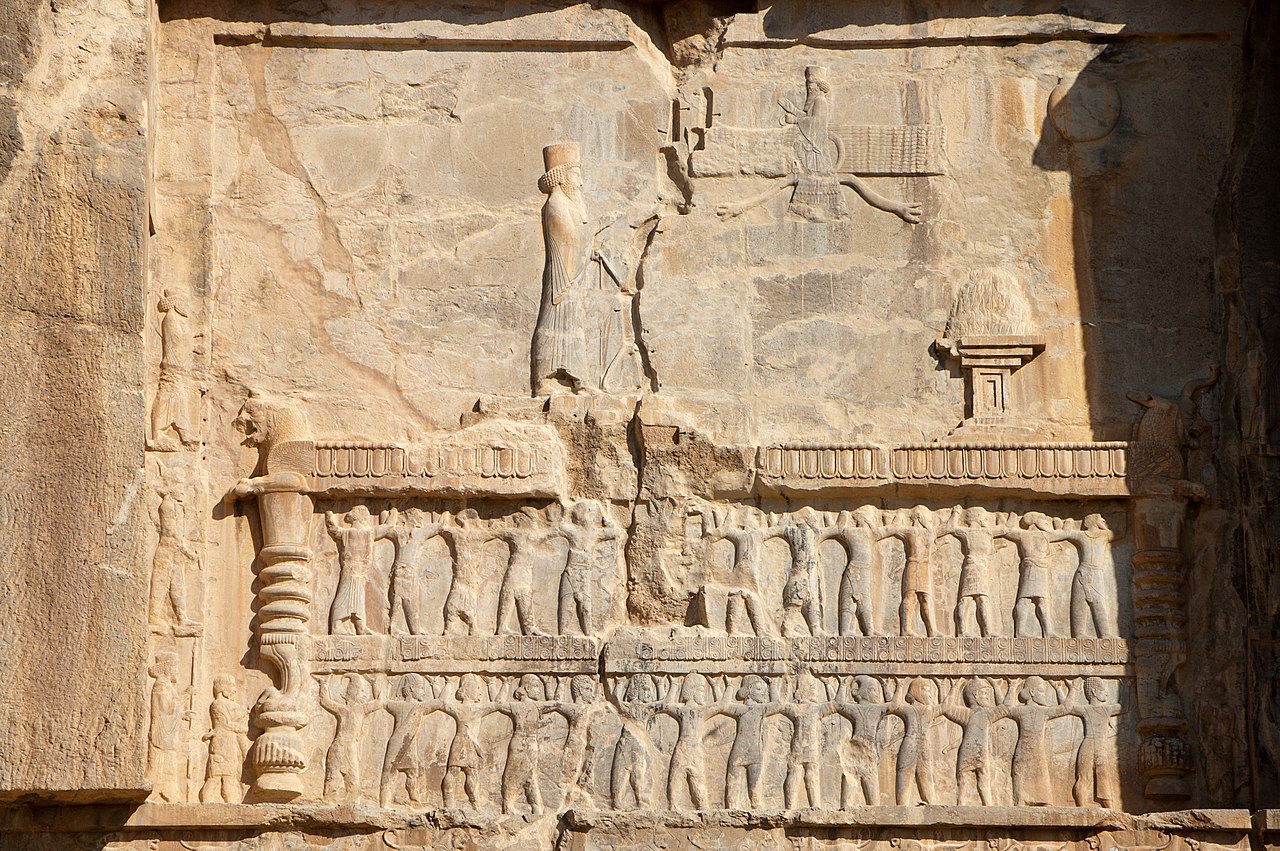
The upper relief of the tomb of Artaxerxes II at Persepolis: the king worships above a platform carried by personifications of the empire's subject peoples. It is an ideological catalogue of imperial diversity, not a muster roll or order of battle. Bruce Allardice · via Wikimedia Commons · CC BY-SA 2.0 source ↗
The hardest part of the catalogue is its numbers, and here the modern correction is at its sharpest. Herodotus builds his host into the millions; no serious historian believes the figure, yet, as T. Cuyler Young observed, even the sceptics have tended to leave the Persians with one of the largest armies in world history, so strong is the pull of the "greatest war ever".[1] Manning sets out the case against the millions on grounds not of arithmetic but of logistics and command: an ancient army spent nearly all its time massed together, drawing water and fodder from a single corridor, waiting its turn at every ford and pass, and could not be split and reassembled at will. Estimating an army's size was a genuinely difficult task even for the general who owned it, full of chances for error and inflation, and Herodotus presents his grand totals as the product of his own reckoning, not of any document.[7] The prudent modern estimates for Xerxes' field army run well below the ancient figures, at most in the low hundreds of thousands and quite possibly far less (the fuller reckoning is given under Xerxes' invasion of Greece).[1]
The Greek image of the Persian army runs through the whole subject: a vast, gaudy, ill-disciplined oriental horde, brave enough but soft, winning by weight of numbers and losing to the hard free spearman of the West, an image that hardened after the Persian Wars into a rhetoric of eastern effeminacy the sources deploy with real artistry. Herodotus himself both used the stereotypes and quietly undermined them for the careful reader: at Plataea he grants the Persians equal courage and strength, and sets their defeat down to equipment and want of skill rather than manhood.[7] He can even lend the King's men their own bewildered dignity, as at Marathon, where the horde watches a handful of Greeks do the unthinkable:
The Persians seeing them advancing to the attack at a run, made preparations to receive them; and in their minds they charged the Athenians with madness which must be fatal, seeing that they were few and yet were pressing forwards at a run, having neither cavalry nor archers.
Herodotus 6.112, trans. Macaulay[7]
Supply, pay and the sinews of war
The logistical arm is less visible than the fighting one, but it was formidable. For the invasion of Greece, Herodotus describes supply depots stocked in advance with grain, water and fodder along the line of march, and a heavy requisition of provisions from the nations the army passed through (7.25, 7.118-120); Cambyses II's march on Egypt depended on an Arabian safe-conduct agreement that secured water for the northern Sinai crossing, while sea transport supported the wider campaign.[2] The same network that carried the king's post carried his armies: the Royal Road and its system of staged, measured highways, with their provisioned stations, were as much a military artery as an administrative one, and the depots were laid along the lines of march they defined. At the level of the individual soldier, the Babylonian documents show the system working from below: contracts like the well-known Gadal-iāma text record exactly what equipment a landholder was to bring to the muster, down to the horse, the armour and the arrows.[4] Manning's reading of these documents overturns an old story. The substitution of cash for personal service, and the borrowing of horses and gear, long read as symptoms of a military gone soft, were in fact sensible responses to a universal problem, that those best able to bear the expense of war (the older and propertied) are not always those most willing to fight; the same solutions appear in medieval Europe's scutage and in the American Civil War's commutation, and none of them shows an army in decay.[1] The land-for-service holdings shade into a wider institution, the military colony: bodies of soldiers, often moved from one end of the empire to the other, settled on crown land against a standing obligation to muster. Iranian and other military settlers were planted through Anatolia and Babylonia on this principle, and the frontier garrisons were paid and rationed communities of much the same kind. In the Near East, Manning stresses, unlike the aristocratic world that shaped the Greek and Latin sources, receiving a wage or an estate for service carried no stigma at all, so the sharp modern line between the honourable citizen-soldier and the despised mercenary largely dissolves.[1]
The navy
The empire was a land power that acquired, when it needed one, a first-class fleet, for it did not build ships or man them from Persia. The war-fleets were furnished by the maritime subject peoples, the Phoenicians above all, with the Ionian Greeks, the Egyptians and the Cypriots; the king ordered their construction as requirement dictated and crewed them from these seafaring nations.[2] Each ship, Farrokh writes, carried a command contingent of thirty Iranians, Persians, Medes or Saka, under a captain called the navpati.[5] Herodotus gives Xerxes a fighting fleet of 1,207 triremes, and here too the round figure invites the same scepticism as the army totals.[2] The Phoenician squadrons carried a special cachet, and it was the loss of the fleet in the narrows at Salamis, more than any defeat on land, that broke the invasion of Greece, a reversal the Athenian veteran Aeschylus staged for his own city within a decade.
The reliance had a strategic logic and a matching weakness. Sea power let a continental empire reach across the Aegean and hold the islands and the Ionian coast, and the imperial fleet, put together with the Syrian coastal cities probably as early as Cambyses' conquest of Egypt, became the instrument of Persian ambition once Darius began to operate in the Aegean.[8] But because the ships and their crews were the king's subjects rather than his countrymen, the fleet's loyalty and staying-power were never wholly secure, and a naval defeat cost the crown a resource it could not quickly replace from its own population; the collapse at Salamis, and the melting away of the Ionian and other contingents that followed, showed how a rented navy could come apart. The instrument recovered, and its later history is itself an argument against the picture of Persian decline. In the fourth century the crown's fleets and its silver made it the arbiter of the Aegean: a Persian navy under the Athenian exile Conon destroyed Sparta's sea power at Cnidus in 394, the largest Persian naval victory in eighty years and arguably the high point of Achaemenid sea power, and it was Persian money and ships that underwrote the King's Peace of 387, by which the Great King dictated terms to the Greek states his grandfather had failed to conquer.[8]
Fortification and siege
Siege warfare is thinly documented for the early empire, which is itself significant. The Persians took great cities, Sardis and Babylon fell to Cyrus, and Herodotus' account of the siege of Sardis is among the first glimpses of the army's camel baggage-train. But the elaborate siege-train of towers, rams and engines that the Greek and Roman world associates with the taking of walls is largely a later development; where the early Achaemenids reduced a fortified place they did so by intimidation, treachery, surprise and sudden assault as often as by engineering.[1] The empire's own fortifications, the garrisoned strongpoints at the satrapal seats and frontier posts, were the more constant military fact, the network by which a small standing force held a vast territory between the rare great campaigns.
The modern reassessment gives that network more weight than the set-piece battles it seldom fought. The everyday military reality of the empire was not the grand expedition but the garrison: a body of professional soldiers held in the citadel of a satrapal capital or a frontier fort, its commander answering directly to the king rather than to the satrap, so that no governor held the strongpoint in his own seat.[2] Xenophon describes an annual royal inspection of these garrisons and their commanders, rewarded or removed by its findings; and the documents let the historian watch one from the inside, the detachments at Elephantine drawing pay and rations for generations.[4] It was this dispersed, standing presence, reinforced by the levy and the guard when a real war came, far more than the occasional muster of a great host, that made the empire governable. The great campaigns fill the Greek sources because they involved the Greeks; the garrisons are what actually held the empire together, from the Aegean to the Indus.
Change across two centuries
The army that met Alexander in the 330s was not the army Herodotus had described. The Alexander historians, incurious as they are about the enemy, still imply forces built on a different pattern: drawn up in several lines, with swarms of skirmishers thrown out ahead of the massed spearmen, with cavalry that wore more armour and pressed for hand-to-hand combat, and with new elements, the kardakes and the scythed chariots, where the old catalogue had Immortals and camel-riders.[1] Two centuries had passed and the force had changed. What that change means is the last and largest of the interpretative questions the subject poses.
The inherited answer is decline. In the story the Greek moralists of the fourth century told, and which passed almost whole into the modern histories, the Achaemenid army decayed steadily from the high tide of Xerxes into a soft and overtaxed rabble, its native infantry gone to seed and propped up at the end by hired Greek hoplites who did the real fighting for a decadent nobility. Eduard Meyer and A. R. Burn wrote the later empire in just these terms, economically depressed and ruled by a decadent aristocracy whose subjects had lost the wealth or the will to make soldiers.[1] Farrokh, in a recent popular military history, still tells it largely this way, that "over time the nature of the army changed... less of a professional army," until the kings hired Greeks to fight their battles.[5] The thesis has a long pedigree, and Pierre Briant traced it to its root: the "decadence of Persia" is a construct of Greek political thought, Plato and Xenophon reading a moral decline out of the empire's luxury and its subjection to a single master, a device of Hellenic self-definition rather than a report on a real institution.[9]
Set against the evidence, the thesis does not hold, and taking it apart is among the firmest results of the modern scholarship. The mercenaries are the clearest case. The kings did hire Greeks in growing numbers across the fourth century, but this was neither a Persian peculiarity nor a mark of decay. Paid service was ordinary and respectable throughout the Near East, where kings, nobles and common labourers alike drew precisely measured rations and the Akkadian word for a hired man carried no reproach; the sharp Greek and Roman contempt for the wage, and the whole moral freight the word "mercenary" still carries, belong to one aristocratic culture and do not cross into the Persian world.[1] The Greek hoplite was, besides, simply the best heavy infantry available for hire in the eastern Mediterranean, and a crown rich in silver bought the best; that Athens, Sparta and every Greek tyrant were doing the same in the same decades is rarely called their decline. The cash-and-hire arrangements already described were sound management, not decay.[1]
The kardakes make the point from the other side. They are a genuinely obscure body, named only by classical and Hellenistic writers describing fourth-century events: Strabo makes them young Persians in military training, Nepos and Arrian foot-soldiers and "barbarian hoplites", the lexicographers barbarian troops of no fixed nation. Modern writers have read them as a deliberate Persian effort to raise close-fighting infantry on the Greek model, Duncan Head calling them "a Persian attempt to create an effective close-fighting infantry, by copying the Greek hoplite"; Briant preferred cross-ethnic regiments of uniformly trained professionals.[2][1] Their equipment is unknown in detail and they may have been destroyed at Issus. What they are not is proof of a soft army; they are the trace of an evolving one.
Manning's larger reframing anchors the current picture. The changes visible in the fourth-century Persian army, the deeper formations and the skirmisher screens, the heavier cavalry, the professional infantry and the hired specialists, are not the symptoms of one empire's rot but part of a military transformation running across the whole eastern Mediterranean in the age of near-constant war after 400, carried from army to army by travelling experts, by trade, and by the aristocratic networks of hospitality that moved tactics as readily as men. The forces that fought in the 330s, Persian, Macedonian, Carthaginian, Roman, were all very unlike those of a century before, and the Persian army moved with that tide rather than sinking beneath it.[1] The host that Alexander beat was not obviously worse than the one that had fought the Greek wars a century and a half earlier; it met a better one, under a king whose own title was fresh and contested. The verdict of a long Achaemenid decadence rests, in the end, on the very sources whose moralising the modern reassessment has taken apart.
Primary sources
The ancient evidence, and what each source attests.
- Herodotus, Histories (esp. 7.40-99, 7.211, 9.62-63)
- the fullest ancient account of the army: the march out of Sardis, the great catalogue of the nations at Doriscus, the Immortals and the Apple-bearers, and the fighting at Thermopylae and Plataea, indispensable but shaped throughout by the image of the barbarian host.
- The royal inscriptions DNb and DNa (Naqsh-e Rostam) and DB (Behistun)
- the Persian side, almost silent on organisation but eloquent on the king's martial ideal (the good bowman, horseman and spearman) and on the reach of 'the spear of the Persian man'.
- Xenophon, Anabasis and Cyropaedia; Strabo, Geography 15.3
- the inside view of a Persian field army (Cyrus the Younger's march to Cunaxa), the annual satrapal review of arms and horses, and Persian military training and obligation to serve.
- The Babylonian ḫaṭru documents (the Gadal-iāma contract; the Murašû archive)
- the land-for-service system from below: exactly what horse, armour and arrows a bow- or horse-fief holder owed at the muster, and the substitution and hire that show how conscription actually worked.
- The Aramaic papyri of the Elephantine garrison (TADAE)
- a frontier garrison-community in its own words: Judean and Aramean soldiers in detachments (degel), paid and rationed by the crown, the documentary ground for the standing garrisons.
- The Persepolis Fortification and Treasury tablets
- soldiers as men drawing rations and holding land; the ration allowances that let the modern reckoning of army size proceed from the documents rather than from Herodotus' figures.
- Ctesias and the Alexander historians (Arrian, Diodorus, Curtius Rufus)
- the scythed chariot and the kardakes of the fourth-century army, and the later royal guard, all reported by writers remote from what they describe.
How we know
The study of the Achaemenid army has been shaped, and long distorted, by its dependence on Greek and Roman literature. Nineteenth- and twentieth-century reconstructions (Eduard Meyer, and in the standard reference article A. Sh. Shahbazi's Iranica "Army i") built a coherent picture of Persian tactics and equipment largely out of Herodotus, Xenophon and the Alexander historians; A. Sh. Shahbazi's own account of Persian fighting is among the syntheses that Sean Manning's Armed Force in the Teispid-Achaemenid Empire (2021) subjects to close criticism. Manning's is the specialist monograph and the backbone of the modern account: he argues that many confident modern statements about how the Persians fought (loose formations, reliance on encirclement, archers deciding battles, a dependence on sheer numbers, a long military decline) cannot be supported even on a generous reading of the sources, and that they descend from a literary discourse about soft, numerous, treacherous orientals rather than from evidence. The Companion to the Achaemenid Persian Empire (Jacobs & Rollinger 2021) supplies the current consensus overviews, Christopher Hassan on army structure and logistics (ch. 80), Christopher Tuplin and Bruno Jacobs on organisation and equipment (ch. 81, with the army-catalogue verdict at p. 1162), and Roel Konijnendijk on the legitimisation of war (ch. 79). Kaveh Farrokh's Shadows in the Desert (2007) is a serviceable popular military history, valuable for detail on the contingents and the navy, but it repeats uncritically the "decline" narrative that Manning demolishes, and is used with that caveat. Genuine controversies remain open and are flagged as such: the reading of "Immortals" as a mistranslation of anūšiya; the historical value of Herodotus' army-catalogue; and, above all, the true size of the great invasion armies, where believers and sceptics have argued past each other for a century. A separate strand of the modern work concerns the later empire: the long-held thesis that the Achaemenid army decayed into a mercenary-dependent rabble is now widely rejected. Briant showed the "decadence of Persia" to be a construct of Greek political philosophy (Plato's Laws, Xenophon's Cyropaedia) rather than a fact of the institution, and Manning sets the genuine fourth-century changes, the kardakes, the heavier cavalry and the hired Greek infantry, within a military evolution running across the whole eastern Mediterranean, not a Persian decline. The soundest procedure throughout is to let the documents and the archaeology set the frame and to read the Greek narratives against it, sceptical of the millions, of the short spears, of the scythed chariots and of the tale of decline, while still granting Herodotus his due as a witness who often knew more than he is given credit for.
References
Source key: primary ancient evidence · secondary modern scholarship · consensus an explicitly labelled overview, not a specific citation. Open Source details for the full record.
- ↑ a b c d e f g h i j k l m n o p q r s tsecondary Sean Manning 2021
Source details
Reference. Sean Manning, Armed Force in the Teispid-Achaemenid Empire: Past Approaches, Future Prospects (Oriens et Occidens 32; Franz Steiner Verlag, Stuttgart 2021)
Evidence used. the scythed chariot of modern scholarship 'essentially a creature' of Greek and Latin literature (p. 269); sparabarai a modern convenience (p. 295); the short-spear cliché and the art, with 'no basis for describing the other Persian weapons as inferior' (pp. 293, 295-296); armour not universal (Hdt. 8.113.2, p. 296); the unattested +baivarapatiš/+baivarabam and the reconstructed top of the decimal ladder (pp. 195-196, 279); the Gadal-Jâma contract analysed from p. 159; substitution and commutation as pragmatic solutions, with the scutage and American Civil War parallels (pp. 178-179, 209); the katastasis loan and the Waterloo comparison (p. 210); T. C. Young on the sceptics' outsized armies (p. 320) and 'the vast majority of numbers in literary sources are of no value' (p. 326); Near Eastern siege methods, intimidation, treachery, surprise and sudden assault (p. 335); the 'decadence' thesis of Meyer and Burn traced to fourth-century Greek moralising (pp. 24-27); mercenaries and military colonists, salaried service without stigma in the Near East (pp. 171-172); the kardakes and Duncan Head's 'copying the Greek hoplite' (p. 58); the fourth-century army of the Alexander historians and the Mediterranean-wide military evolution after 400 (pp. 311-312)
- ↑ a b c d e f g hsecondary Christopher Hassan 2021
Source details
Reference. Christopher Hassan, 'Structure of the Army and Logistics' (ch. 80), and Christopher Tuplin & Bruno Jacobs, 'Military Organization and Equipment' (ch. 81), and Roel Konijnendijk, 'Legitimization of War' (ch. 79), in B. Jacobs & R. Rollinger (eds.), A Companion to the Achaemenid Persian Empire (Hoboken, 2021)
Evidence used. the satraps' own forces, the garrison commanders beneath them and the annual review from the central authority, p. 1153; the elite units (Immortals and Apple-bearers, with Darius the spear-bearer of Cambyses) and their echoes under Darius III, p. 1156; the synthesis of standing core, garrisons on active duty and mustered levy, with the fleets built at the king's order and crewed by the seafaring nations, p. 1157; Cambyses' sea-borne supply line and Xerxes' stocked depots and heavy requisition, p. 1158; the army-catalogue 'not to be taken at face value', a rearrangement of the tribute nomoi, Armayor's doubts and Briant's parade-contingent reading, p. 1162; the Immortals' disappearance from the battle narratives after Thermopylae, 'rendering discussion of their tactical function problematic', p. 1172; the navy weighed (the king provided hulls, the subjects crews; Herodotus' 1,207; the Phoenician cachet), p. 1176; the Arab water-arrangement for the Sinai crossing also at p. 408 (A. Kuhrt, 'The Great Conquests', ch. 29); the regional marshal (kāranos) and the increasing decentralisation of military command, with non-Persians such as Memnon appointed, p. 1153; the chiliarch (hazārapati) as commander of the royal bodyguard and controller of access to the king, pp. 888, 1037; the Cardaces (kardakes) as cross-ethnic trained infantry and 'barbarian hoplites', p. 1173
- ↑ a bsecondary A. Sh. Shahbazi 1986 ↗
Source details
Reference. A. Sh. Shahbazi, "ARMY i. Pre-Islamic Iran", Encyclopaedia Iranica, Vol. II, Fasc. 5, pp. 489-499 (published 15 December 1986; updated 9 May 2019): the standard overview of the decimal organisation, the standing army and levy, the Immortal Guard and the Apple-bearers, the wicker shield, and the note that "Immortals" may render an Old Persian anūšiya
- ↑ a b c d eprimary Xenophon
Source details
Reference. Xenophon, Anabasis (esp. 1.7-1.8, the army of Cyrus the Younger at Cunaxa) and Oeconomicus 4.5-6 (the annual satrapal review); Strabo 15.3 (Persian training and service), 11.13.7 (the Nesaean horses of Media) and 11.14.9 (the 20,000 Armenian foals for the Mithrakana, via Kuhrt 2007); the Babylonian ḫaṭru documents, esp. the Gadal-iāma (Gadal-Jâma) equipment contract (Murašû archive; analysed in Manning 2021 from p. 159); and the Aramaic papyri of the Elephantine garrison (TADAE)
Evidence used. the documentary evidence for organisation, land-for-service, pay and supply
- ↑ a b csecondary Kaveh Farrokh 2007
Source details
Reference. Kaveh Farrokh, Shadows in the Desert: Ancient Persia at War (Osprey, 2007), pp. 76-79: the sparabara shield-and-archer file, the ethnic contingents, the cavalry, and the Phoenician-crewed navy with its Iranian command contingents
Evidence used. a popular military history useful for detail but repeating the "decline" narrative
- ↑ a bprimary The Old Persian royal inscriptions: DNb
Source details
Reference. The Old Persian royal inscriptions: DNb (Darius's tomb, the king's own martial ideal, "as a horseman... as a bowman... as a spearman"), DNa ("the spear of the Persian man has gone far"), and the Behistun narrative (DB)
Evidence used. contemporary and Persian, but ideological and almost silent on military detail; translations quoted: Kuhrt, The Persian Empire (2007 one-vol. ed.), DNa §4 at p. 503 and DNb §2h at p. 505
- ↑ a b cprimary Herodotus
Source details
Reference. Herodotus 7.61-99 (the catalogue of Xerxes' army), 7.41 (the Apple-bearers), 7.83 (the Immortals), 7.118-120 (feeding the host), 9.62-63 (the Persians at Plataea); 6.112 (Marathon); 1.80 (the camels at Sardis)
Evidence used. the fullest but most problematic narrative source
- ↑secondary Pierre Briant 1989
Source details
Reference. Pierre Briant, 'Histoire et idéologie: les Grecs et la "décadence perse"', in Mélanges Pierre Lévêque, vol. 2: Anthropologie et société (Annales littéraires de l'Université de Besançon 377; Besançon, 1989), pp. 33-47
Evidence used. the 'decadence of Persia' shown to be a construct of Greek political thought (Plato, Laws; Xenophon, Cyropaedia VIII), a topos of Hellenic self-definition read out of Persian luxury and subjection to one master, not a description of the real institution
Cite this entry
“Warfare & the Army”, in Achaemenica: An Encyclopaedia of the Achaemenid Persian Empire (entry warfare-and-the-army), https://achaemenica.org/articles/warfare-and-the-army, version of 2026-07-24.
Show BibTeX and RIS
@misc{achaemenica-warfare-and-the-army,
  author       = {{Studio Daric}},
  title        = {Warfare & the Army},
  year         = {2026},
  howpublished = {\url{https://achaemenica.org/articles/warfare-and-the-army}},
  note         = {Achaemenica: An Encyclopaedia of the Achaemenid Persian Empire. Version of 2026-07-24}
}
TY - ELEC AU - Studio Daric TI - Warfare & the Army T2 - Achaemenica: An Encyclopaedia of the Achaemenid Persian Empire PB - Studio Daric PY - 2026 DA - 2026/07/24 UR - https://achaemenica.org/articles/warfare-and-the-army ER -
The article's metadata is embedded on the page, so Zotero, Mendeley and other reference managers detect it automatically.
Corrections and suggestions
Every entry is checked against its sources, but errors and omissions are always possible. If you have found an inaccuracy, or can suggest an improvement, please email a correction. Each note is read and checked against the sources before any change is made.
Related entries
The Satrapy System · The King of Kings · The Immortals · Herodotus, The Histories · Xerxes I · Xerxes' Invasion of Greece (480–479 BCE) · The Sources & How We Know · The Behistun Inscription (DB) · Naqsh-e Rostam · Xenophon · Ctesias, The Persica · Darius I · The Daric (and the Siglos) · The Murašû Archive
Referenced by: Artaxerxes II · Artemisia I of Halicarnassus · Cyrus the Younger · Mardonius · The Battle of Cunaxa (401 BCE) · The Battle of Marathon (490 BCE) · The Battle of Mycale (479 BCE) · The Battle of Plataea (479 BCE) · The Battle of Salamis (480 BCE) · The Battle of Thermopylae (480 BCE) · The Conquest of Egypt by Cambyses · The Ionian Revolt (499–494 BCE) · The Peoples of the Empire · The Retreat of the Ten Thousand (401–399 BCE) · The Saka (Scythians) · The Xerxes Canal
Last updated 2026-07-24.