The forcing of the coastal pass of Thermopylae by Xerxes I in high summer 480 BCE, during his invasion of Greece. A small allied Greek army under the Spartan king Leonidas held the defile for some days against the King's advance, was outflanked by a Persian column sent over the Anopaea mountain path, and was destroyed; the road into central Greece lay open. In later Greek memory, above all in Herodotus, it became the supreme tale of free men choosing death over submission, the '300 Spartans' against the countless horde. From the empire's side it was something far smaller and wholly successful: the costly but decisive forcing of a chokepoint by a king performing kingship, a victory the Greek sources bury under the glory of the men who lost. The gap between those two readings, and the near-total dependence on one patriotic Greek narrator, is the governing problem of the battle's whole history.
In the late summer of 480 BCE the army of Xerxes came up against a narrow coastal pass in central Greece called Thermopylae, the 'Hot Gates', where a small allied Greek force under the Spartan king Leonidas barred the road south. For some days the Greeks held the defile; then a Persian column, guided by a local man over a mountain track, came down behind them, and the defenders who stayed were surrounded and killed. The King's road into central Greece was open, and within weeks Athens itself was taken and burned. Thermopylae is, without rival, the most celebrated defeat in Western memory: the heroic last stand, the '300 Spartans', the free men who chose death over the despot's yoke. That reading is Greek, and it is very old. Beside it must be set the harder fact that underpins the whole subject of these wars. Thermopylae was a Persian victory, a successful forcing of a fortified chokepoint, and it is known to us almost entirely through the people whom the King defeated there, and above all through one of them, Herodotus, writing two generations later with a purpose that shaped every line. Reading the battle from the empire's side takes nothing from the Spartans' courage; it asks instead what the fighting actually was, why it loomed so vastly larger in Greek memory than in imperial fact, and how a court that treated defeat as unthinkable would have understood a chokepoint stormed at some cost and the enemy's forward army wiped out.
The single source and its design
Everything of consequence about Thermopylae comes from Herodotus, whose seventh book narrates the campaign at length and gives the battle some thirty chapters (7.201–233). Later writers, Diodorus (drawing on the fourth-century Ephorus), Plutarch, Ctesias, add embroidery from the same Greek stream; none is independent of it, and the fourth-century additions, such as Leonidas' night raid on the King's tent, are demonstrably fictional.[1] There is no Persian account of any kind. Amelie Kuhrt states the resulting dependence flatly: for the empire's political and military history after Darius's accession "we are dependent on Graeco-Roman writers, with Herodotus' masterly narrative dominating the picture."[2]
That narrative has a shape, and it is the shape of a moral. For Herodotus the invasion is a lesson in the ruin that overreaching pride draws down on itself and in the strength that free men take from their freedom, and Thermopylae is the pattern-piece of the whole: a handful of free men, disciplined by their own law, holding at bay a king who can move millions but command no true soldiers. John Hyland, whose recent study is the fullest treatment of the campaign from the Achaemenid side, shows how the account of the advance from Thessaly to Athens is built as 'a litany of escalating setbacks, bad omens, overlooked warnings', in which Xerxes' soldiers 'fall in countless numbers at Thermopylai, displaying their lack of manliness and requiring the whip to push them into combat', while 'all Xerxes's successes are ephemeral, and divine intervention is only credited in support of Athens and its allies.'[1] The reader must hold this at every point: the facts Herodotus reports are often sound, but the frame around them is a Greek argument, and at Thermopylae the argument is at its most seductive and least neutral.
The ground and the coast road
The battle was dictated by geography, and so was the campaign that led to it. A great army moving south out of Thessaly into central Greece, with its baggage train and its fleet coasting alongside to feed it, had few roads it could take, and the main one ran along the narrow shelf of land between the Malian Gulf and the mountains, pinching at Thermopylae into a defile where in 480 the sea came almost to the foot of the cliffs. The King did not stumble into the pass. The coast road was the line a large force with seaborne supply had to follow, and the Greeks chose it for exactly that reason: to stop the army where its numbers could not be used, while their own fleet held the parallel strait of Artemisium a few miles offshore. The pass and the strait were a single defensive line, and the fate of one settled the fate of the other; when the land position fell, the fleet at Artemisium, which had fought its own indecisive actions against the Persian ships, broke off and withdrew.
Whatever else it was, the plan behind the invasion was competently made, and the Greek picture of a blundering horde obscures it. How and Wells long ago credited the whole advance, 'the elaborate care taken in bridge building, in making roads and canals, in storing provisions, above all the steady advance of huge forces without any sign of failure in supplies', with 'careful organization and competent leading', the one real weakness being the rigid dependence of the land march on the fleet keeping pace offshore.[3] That dependence is the key to the site. The King had to force the coast road because his army could not be fed along any other, and the Greeks had to hold it because losing it uncovered everything to the south.
Not three hundred: the allied Greek force
The first correction is to the cast. The 'three hundred Spartans' of legend were the Spartan citizen core of a much larger allied army, and they were never alone. Leonidas led a coalition contingent drawn from across central Greece and the Peloponnese: besides his 300 Spartiates, several thousand Peloponnesian hoplites, some seven hundred Thespians who died with the Spartans to the last, four hundred Thebans, Phocians posted on the mountain, and Locrians, with helots and other attendants swelling the number. Herodotus' own casualty notice at the end preserves the reality behind the slogan: he speaks of 'four thousand' of the Peloponnese who fought there, and Hyland reasonably reads the actual last-day dead as something on the order of two thousand men, including the famous 300 and the 700 Thespians, plus perioikoi, helots and a handful of others.[1] The reduction of this allied host to '300 Spartans' is itself a piece of the later memory, a Spartan and then a pan-Hellenic compression that wrote the other cities out of the story.
The defenders' aim was limited and, from the coalition's side, provisional. Many of the Peloponnesians wanted to fall back to the Isthmus of Corinth and abandon everything north of it. Herodotus records the quarrel in Leonidas' camp, and the Spartan's decision to hold:
To the rest of the Peloponnesians then it seemed best that they should go to the Peloponnese and hold the Isthmus in guard; but Leonidas, when the Phokians and Locrians were indignant at this opinion, gave his vote for remaining there, and for sending at the same time messengers to the several States bidding them to come up to help them, since they were but few to repel the army of the Medes.
Herodotus 7.207, trans. Macaulay[4]
The frontal assaults: the failure at the chokepoint
The fighting followed from the ground. Thermopylae was a defile perhaps a mile long and, at its narrowest, only about thirty feet wide, hemmed between the cliffs of Mount Kallidromon and the sea, with an old wall across it that the Greeks repaired. In such a space the fight came down to close combat on a front only a few dozen men wide, where the heavier arms and longer spears of the Greek hoplites told. For the first two days the frontal assaults failed. Herodotus makes Xerxes send in first the Medes and Kissians, then his best infantry, and reports the lesson the King is made to draw: "They made it evident to every man, and to the king himself not least of all, that human beings are many but men are few."[4]
When the Medes were roughly handled, the King committed the corps the Greeks called the Immortals, the standing royal guard of ten thousand, under the same Hydarnes who would lead the flanking march. They fared no better, and Herodotus fixes the reason in the terrain and the weaponry, not in any failure of courage:
When however these also engaged in combat with the Hellenes, they gained no more success than the Median troops but the same as they, seeing that they were fighting in a place with a narrow passage, using shorter spears than the Hellenes, and not being able to take advantage of their superior numbers.
Herodotus 7.211, trans. Macaulay[4]
The standard modern study of the Achaemenid army draws the sober conclusion the narrative itself supports: at Thermopylae the guard was 'deployed only when Medes and Elamites fail', and was 'equally unsuccessful at uphill attack on a restricted front.'[5] Even the tidy explanation from the weapons should be held loosely. Manning cautions that no surviving artwork supports the short Persian spear, that the detail sits inside a Greek rhetoric of abuse, and that veterans interviewed decades later "may well have convinced themselves that Persian spears were short, whether they learned that on the Theban plains or at a symposion."[6] There is nothing here that need surprise. A chokepoint neutralises numbers by design; the finest army in the world, fed piecemeal into a thirty-foot gap against braced spearmen, will be checked, as many armies since have been checked, until the position is turned. The repulse of the guard has made it, through Thermopylae, the emblematic Persian unit, though its Greek name and its round number are Herodotus' own, and the question of what the sources really establish about it is a separate one (see the Immortals).
The turning of the pass
What the frontal assaults could not achieve, local knowledge did. A man of Malis named Ephialtes, hoping for a reward, told the King of a mountain path, the Anopaea, that ran around the defile and came down behind it. Xerxes sent Hydarnes and his column over it by night; the Phocian guards on the track, surprised at dawn and supposing themselves the main target, drew off to a hilltop, and the Persians passed on and descended into the Greeks' rear.
The turning is almost always told as a tale of treachery, and Herodotus tells it so; but from the Persian command's side it was a straightforward and well-executed piece of generalship. A frontal position that cannot be carried is turned, and the King's staff found the path and used it as a competent commander should. Herodotus implies that the whole ten thousand of the guard made the night march, but the topography forbids it: scholars have long doubted that so large a force could have covered the rough track in the time, and a picked column of perhaps two thousand would have sufficed to cross before dawn, scatter the thousand Phocians set to watch the path, and turn the pass.[1] The decisive stroke was delivered by a detachment doing exactly what elite troops are for. The disaster had a Greek author as much as a Persian one. Schmitt observes that the pass fell 'thanks to the treachery of Ephialtes' but also because 'the strategists responsible for this location had inexcusably overlooked this alternative detour on their reconnaissance.'[7] The heroic stand was made both possible and necessary by a Greek failure of scouting.
The last stand
Learning that he was being encircled, Leonidas sent away the bulk of the allied army and kept his own Spartans, the Thespians who refused to leave, and the Thebans, to hold the pass to the end and cover the retreat. The last stand, when it came, was murderous and, on Herodotus' telling, magnificent: the defenders fought in the widening ground beyond the wall until their spears broke and they used swords, then hands and teeth, and Leonidas fell, and over his body a great struggle raged. Herodotus names, on the Persian side, a cost felt in the King's own house:
In this fighting fell Leonidas, having proved himself a very good man, and others also of the Spartans with him... Moreover of the Persians there fell here, besides many others of note, especially two sons of Dareios, Abrocomes and Hyperanthes.
Herodotus 7.224, trans. Macaulay[4]
The deaths of two of the King's half-brothers, sons of Darius, register the reality that the victory was bought with blood, including noble Persian blood, and would have required funerary honours at court. The mound at the pass traditionally identified with the last stand has its own testimony, a scatter of excavated arrowheads, among the few physical traces any battle of these wars has left.[8]
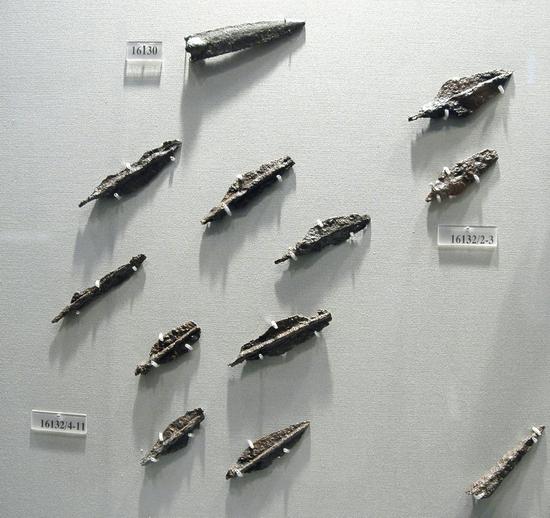
Iron arrowheads recovered at Thermopylae, among the limited physical traces of the battle and material evidence for the missile fighting described by the literary sources. Marco Prins / Livius.org · via Wikimedia Commons · CC0 source ↗
Even so, the Greek reader should notice what the narrative quietly concedes: the pass was forced, the enemy's forward army was destroyed, and the King's advance resumed on schedule.
The whip, the count, and the manufacture of a Persian rout
Two details of Herodotus' account do the heaviest ideological work, and both dissolve under scrutiny. The first is the whip. On the final day, Herodotus has the Persian commanders driving their own men forward into the Greeks 'with whips', so that many were trampled or forced into the sea; the image of soldiers flogged into battle is one of his recurring devices for marking the difference between free Greeks and the King's slaves. Amelie Kuhrt, editing the passage, states the plain objection: 'There is no other evidence for Persian soldiers fighting under physical duress.'[9] The same motif attaches to the crossing of the Hellespont, said to have been done 'under whips', where Kuhrt observes that a comparison with Persian ceremonial suggests the whips were far more likely used 'to regulate the mass of soldiers moving across a fairly narrow bridge' than to flog them onward.[10] The whip at Thermopylae is a literary sign; it records nothing of Persian practice. Cawkwell widens the indictment: through the whole narrative "ran a thread of contempt for the Persian army," from the whips to the pointed felt hats, even as Herodotus concedes that at Thermopylae Persians fought and died beyond reproach; what the reader misses is "any sense of the greatness of the Persian Army" that had taken Egypt and the Indus, achievements "not accomplished by soft and effeminate men."[11]
The second is the body count, and here Herodotus' arithmetic collapses on inspection. He puts the King's dead at Thermopylae at twenty thousand against the Greeks' handful, and then, in a set-piece of contempt, has Xerxes hide almost all his own corpses and invite the fleet ashore to view the enemy dead and 'see how he battles against the senseless men who hoped to overthrow the might of the king', a spectacle the assembled sailors are made to find laughable.[12] The numbers are impossible. Hyland notes that the twenty thousand is a fantasy figure, that far fewer Persians can even have engaged in the narrow space, and that the true Persian toll may well have stayed 'well under 1,000', the number of bodies later observers claimed to have counted before assuming the rest were hidden.[1] Herodotus' own figure of four thousand Greek dead, meanwhile, seems to be an error drawn from the total Peloponnesian roster.[1] Once the fiction of catastrophic Persian losses is set aside, the manufactured 'spectacle of failure' collapses with it, and a very different Persian event comes into view.
The watching king and Leonidas' head
That different event is a victory staged as a victory. Herodotus reports that Xerxes watched the fighting from a throne set on high ground and, in his fear for his army, sprang three times from his seat; the watching King, made the impotent witness of his own men's failure, is one of the narrative's fixed images. Read from the Persian side, the royal observation is not a Greek invention to be explained away but a genuine element of Achaemenid kingship. Royal oversight of a battle carried onto the field the ceremony of the audience, the enthroned King before whom his subjects came; his visible presence was itself an act of rule, tying the day's outcome to his own person and to the god who upheld him, and meant to make his men fight the harder. Briant gathers the dossier of the royal gaze across the campaign: the marble loggia at Abydos, the review at Doriscus, the throne above the pass, and at sea the court scribes recording which captains had fought with distinction, so that "every man of them did his best for fear of Xerxes, feeling that the king's eye was on him."[13] A hillside station overlooking the pass, from which the King could watch and be seen to watch, fits the practice exactly, whatever Herodotus does with the trembling.
The treatment of Leonidas' corpse tells the same story. Herodotus presents Xerxes' order to behead the dead king and fix his head on a pole as an ugly fit of rage, an aberration from the Persians' usual respect for brave enemies. The Achaemenid and Assyrian record makes it something else: the standard, meaningful punishment of a rebel. Darius at Behistun records the impaling and the decapitation-and-display of the 'liar kings' who rose against him, and Artaphernes had inflicted the like on the rebel Histiaeus at the end of the Ionian Revolt.[1] From within the King's ideology, mounting Leonidas' head displayed the suppression of the Lie and the punishment of a wicked opponent, one whom Xerxes could plausibly cast, given the Spartan leadership's role in the deposition of the legitimate king Demaratus (then in Xerxes' own camp) and its murder of Darius' envoys, as a follower of falsehood justly destroyed.[1] The viewing of the piled Greek dead served the same end that Assyrian kings and Achaemenid seal-images served, the visualisation of the total defeat awaiting those who defied the King; the seal impression from Xerxes' own treasury, showing a royal hero spearing a kneeling hoplite and dragging captives by a rope, is the iconographic twin of the scene at the pass.[1] Even the branding of the surviving Theban captives, which Herodotus reports as another cruelty, was in fact the ordinary Achaemenid marking of dependents and property, well attested in Babylonia and Egypt, and here a permanent record of ownership and of royal triumph.[9]
The Demaratus dialogues
The battle's ideological engine was running before a blow was struck, in the dialogue Herodotus stages between Xerxes and the exiled Spartan king Demaratus, who marches with the Persian army as an adviser and a living reproach. As the host moves south the King asks whether the Greeks will really dare to stand against him, and reasons that free men, having no master to compel them, cannot be made 'compelled by the lash to fight with greater numbers, being themselves fewer'.[4] Demaratus answers with the paradox that Herodotus makes the key to the whole war: the Spartans are free, and they obey, because their freedom is itself a kind of service to their law.
For though free, yet they are not free in all things, for over them is set Law as a master, whom they fear much more even than thy people fear thee.
Herodotus 7.104, trans. Macaulay[4]
The speech is Herodotus' invention, political theory placed in the mouth of a character. The law (nomos) that the Spartans obey is set over them as a master (despotes), the very word for the King's own rule, so that the contrast Herodotus draws is not between obedience and freedom but between two objects of obedience: the subject who submits to a man, whose command changes with his mood, and the citizen who submits to a law he counts as his own and which never varies. On the day of the last stand the point is made in deeds, when the defenders fight on past hope because the law forbids them to leave their post. The staging is as pointed as the argument. It is a Greek truth, and Herodotus can only make it carry by putting it in the mouth of a Spartan king who has been driven from his own city and now serves the enemy, the insider who knows Sparta and the outsider free to say what a loyal Spartan at court could not. Demaratus belongs to a type Herodotus uses throughout, the truthful adviser whose sound counsel the overconfident King hears and sets aside, and his part is to voice, from inside the Persian camp, the very reading of the war the audience is meant to take away. The dialogues have long been admired as some of the best writing in the account of the campaign, and they are also its most finished piece of persuasion: the free man's answer to the throne, given the authority of the King's own guest and the shape of a tragic warning.
The strategic question: delay, defeat, or sacrifice
What Thermopylae was worth as strategy has been read three ways, and the readings pull against one another. The first, and the oldest, is the traditional military reading: that it was a delaying action, the pass and the strait of Artemisium a single screen thrown across the King's road to hold him in the north while the states to the south prepared, so that the stand bought the Greeks time. The second, resting on the failure of reconnaissance that Schmitt underlines, is that it was a failed defence, close to a blunder: the northern line was taken up and then lost through the very oversight that let the Persians find the Anopaea path, so that the delay it bought was measured in days and cost a picked force for no lasting gain.[7] The third, which is Herodotus' own, is that its worth was never military but exemplary: a deliberate sacrifice, Leonidas remaining in obedience to an oracle that a Spartan king must die if Sparta were to stand, whose value lay in the resolve it kindled in the states behind him.[4]
Seen from the empire's side, the first two readings converge on the same small figure. The delay was slight and the King's timetable held; the losses, set against the host, were trivial. Hyland stresses that 'the vast majority of Xerxes's army waited out the fighting in camp' and marched on the moment the road cleared, and that the far greater exertion of these weeks was not the battle but the feeding of the host across a stripped countryside as it moved on Athens, a task the imperial supply system met without a crisis.[14] Briant's verdict on the fortnight is the imperial one: whatever the cost at the gate, "from the perspective of the Persian general staff, the objective had been achieved: the road to Greece was open."[15] The Persian success in central Greece was as much diplomatic as martial. Thessaly, Boeotia, Thebes above all, and much of the centre went over to the King, and the coalition that had sent a few thousand men to the pass could not hold the line behind it; Athens was evacuated, taken, and its temples burned.
The third reading, the sacrificial one, is the only one on which the memory and the event agree, and it belongs wholly to the Greek side of the ledger. Whether Leonidas stayed for the oracle, or to cover the retreat of the others, or because a Spartan did not retreat, the stand's power was always in what it meant rather than in what it achieved. What it did not do is the true measure of the distance between the two histories. It did not decide the war, which ran on through the sea-fight at Salamis that autumn and was settled only the next summer, on land at Plataea and at Mycale. It did not open some new and irresistible phase of conquest; it forced one gate on the road to a city the King had come to punish, and it cost the empire nothing it could not spare. Set in the frame of a realm that reached from the Indus to Thrace, the forcing of Thermopylae was a successful tactical operation on the far western edge of the world, the kind of thing the King's armies had done to walled cities and mountain passes for a generation.
The making of the legend
The enduring power of Thermopylae belongs to the Greek imagination and to the uses it made of the stand. The compression to '300 Spartans', the cult of Leonidas, and above all the epitaphs began the work at once. Herodotus preserves the couplet, ascribed to Simonides, that was cut over the Spartan dead:
Stranger, report this word, we pray, to the Spartans, that lying here in this spot we remain, faithfully keeping their laws.
Herodotus 7.228, trans. Macaulay[4]
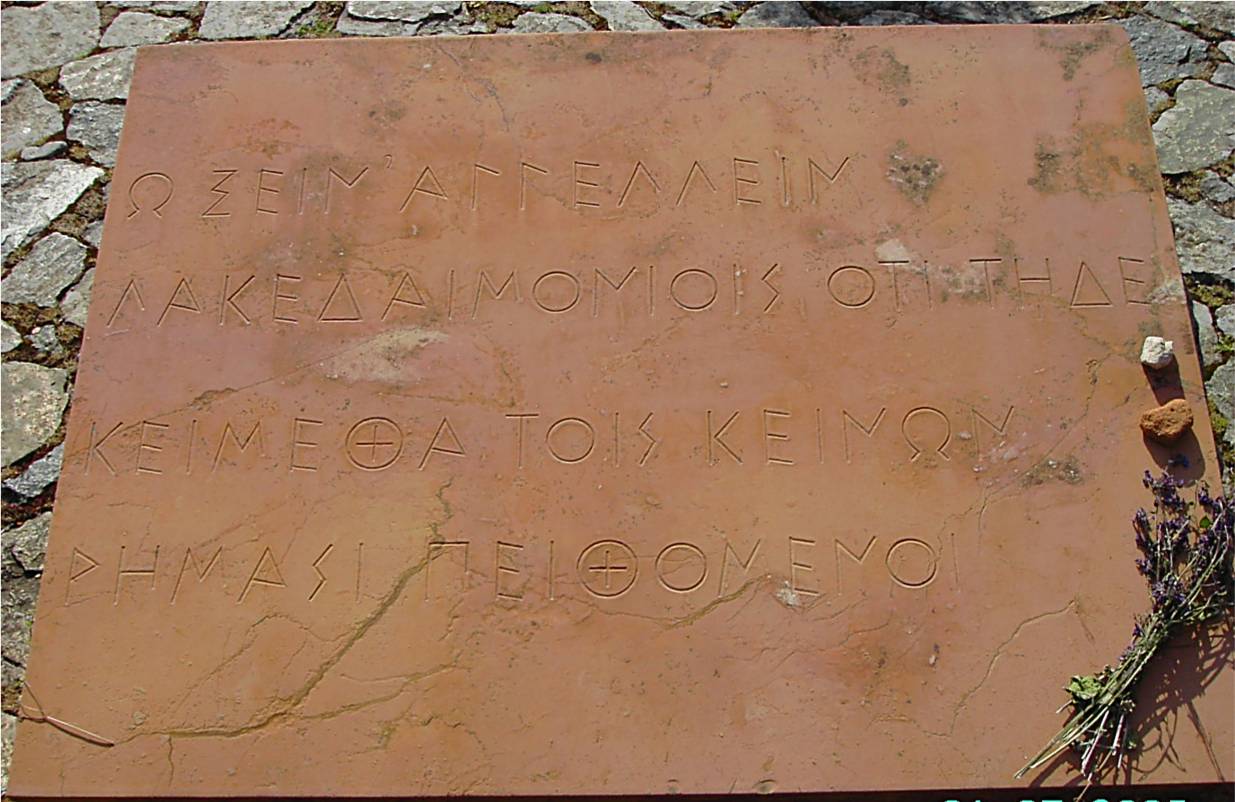
A modern memorial plaque at Thermopylae reproducing the famous epitaph ascribed to Simonides. It commemorates the Spartan dead but is not the ancient inscription recorded by Herodotus. Sofie Debognies / Napoleon Vier · via Wikimedia Commons · CC BY-SA 3.0 source ↗
The line is famous, and it is propaganda in the exact sense: the self-image of free men who answer to no master but a law they hold as their own, set against the King's subjects, imagined as driven by fear of a man and the lash. Dieneces' answer to the warning that the Persian arrows would blot out the sun, that then the fighting 'would be in the shade and not in the sun', is of a piece, the free man's contempt for the horde, unforgettable, and a Greek line.[4] From these beginnings the reading of the battle as liberty's sacrifice against Asiatic despotism grew for two and a half millennia, down to the modern nationalist and cinematic uses of 'the 300' (see the Immortals on the guard's afterlife in that image).[1] The historian's craft has made the West remember a Persian defeat where there was a Persian victory. That inversion is the real subject of Thermopylae: not a denial of the Spartans' valour, which was real, nor of their sacrifice, which was total, but the recognition that the event's vast place in memory is a monument the victors' descendants built, and that the empire, which forced the pass and marched on to burn Athens, would have recorded, had it recorded anything, only a gate opened and a wicked enemy justly destroyed.
Primary sources
The ancient evidence, and what each source attests.
- Herodotus, Histories 7.201–233 (with the Demaratus dialogues 7.101–104, 7.209)
- the one continuous narrative of the battle: the quarrel in Leonidas' camp, the three days of frontal assault, the turning of the pass by the Anopaea path, the last stand, and the dialogues that frame the whole.[4]
- Herodotus, Histories 8.24–25
- after the battle, Xerxes hides almost all his own dead and shows the fleet the piled Greek corpses: the 'spectacle of failure' that the Persian-side reading takes apart.[12]
- Diodorus Siculus 11.4–11 (from Ephorus), Plutarch and Ctesias
- the later Greek tradition, dependent on the same stream and adding later embellishments, rejected as fiction.[1]
- The Behistun inscription (DB) and the fate of Histiaeus
- the Achaemenid comparanda for the display of Leonidas' head: the standard punishment and public exhibition of a defeated rebel, the visual language of the suppressed 'Lie'.[1]
- The battlefield archaeology of the pass
- the arrowheads from the mound traditionally identified with the last stand, among the few physical traces any battle of these wars has left.[8]
How we know
The evidence is almost all on one side. Herodotus (Book 7, esp. 7.201–233) is a Greek writing about two generations after the event, whose battle narrative, detailed and often well informed, is shaped throughout by the contest he draws between Greek liberty and Asian autocracy and is the source both of the '300 Spartans' tradition and of the notorious figure of 20,000 Persian dead; the later Greek tradition descends from him and adds later elaboration; and no Persian source of any kind survives. The task of a Persian-side reading is therefore correction rather than counter-narrative: to weigh how far the one surviving account can be trusted, point by point, and to set beside it the little the Achaemenid record itself supplies. The Persian-side reconstruction followed here is chiefly that of John O. Hyland, 'Persia's Greek Campaigns' (2025), ch. 8 ('Xerxes's Greek Campaign as Heroic Journey', pp. 231–247) and the logistics chapter (pp. 224–230): the true Persian death toll probably well under 1,000 against Herodotus' 20,000; the flank march made by a detachment of perhaps 2,000, not the full guard; the whip as a Herodotean literary sign, not Persian practice; the watching king as genuine Achaemenid ceremonial rather than a topos to be explained away; and the display and beheading of Leonidas' body, and the branding of the Theban captives, as standard Achaemenid punishment-of-the-Lie and marking of dependents, with the Behistun impalements and the fate of Histiaeus as precedents.
The primary passages are quoted verbatim from the public-domain G. C. Macaulay translation (1890) and, where noted, from Amelie Kuhrt's renderings. Kuhrt, 'The Persian Empire: A Corpus of Sources' (2007), ch. 7C, supplies the texts with commentary and two of the decisive notes used here, that no other evidence has Persian soldiers fighting under physical duress and that the whips at the Hellespont were more likely used to regulate a crowd on a narrow bridge than to flog soldiers, together with the reading of the 'branding' of the Thebans as a mark of ownership. The concise scholarly narrative, including the 'gross exaggerations' in Herodotus' numbers and the Greek strategists' inexcusable failure to reconnoitre the Anopaea path, is from R. Schmitt, 'Greece i. Greco-Persian Political Relations', Encyclopaedia Iranica XI/3 (2002), pp. 292–301. The nature of the corps the Greeks called the Immortals, its repulse in the pass and the unreliability of Herodotus' army catalogue draw on Tuplin and Jacobs in the 'Companion to the Achaemenid Persian Empire' (2021) and on Manning (see the Immortals and warfare and the army); here the guard figures only as the elite infantry checked at the chokepoint. Manning ('Armed Force in the Teispid-Achaemenid Empire', 2021) supplies two correctives used directly: the scepticism about the short-spear explanation of the repulse (pp. 298–299, the detail embedded in a Greek 'rhetoric of abuse' and unsupported by art) and the note on the arrowheads from the mound (p. 244), the battle's rare physical trace. How and Wells (1928), Appendix XX §1, anticipated the modern reappraisal of the campaign's competence, crediting the advance with 'careful organization and competent leading' and locating its weakness only in the rigid land-sea co-operation. Cawkwell (The Greek Wars, 2005, p. 9) states the running bias plainly, a 'thread of contempt for the Persian army' through the whole tradition; Briant (pp. 304, 528–531) gives the royal-spectacle dossier and the staff verdict that with the pass forced 'the road to Greece was open'. The wider campaign frame (the expedition as royal enterprise; the demolition of Herodotus' millions) draws on Hyland, Manning and Briant (see Xerxes' invasion of Greece, Salamis and Marathon).
Two features of the account resist any documentary check and remain literary rather than factual questions, but they are central to how the battle has been read. The Demaratus dialogues (7.101–104, and the second exchange at 7.209) are Herodotus' own composition and function as political theory: the Spartans' freedom shown as a stricter obedience, to a law set over them as their 'master', against the King's subjects who obey a man. And the strategic meaning of the stand, read variously as a delaying action, as a defence lost through a failure of scouting, and as a deliberate sacrifice whose worth was exemplary, cannot be fixed from a single patriotic source that never states the coalition's real intentions. Genuine and probably permanent uncertainties remain of the ordinary kind as well: the exact route and length of the Anopaea march, the size and composition of the allied Greek force, whether Xerxes observed the battle in person, and the true casualty figures on both sides, which the one surviving source exaggerates and never reliably counts.
References
Source key: primary ancient evidence · secondary modern scholarship · consensus an explicitly labelled overview, not a specific citation. Open Source details for the full record.
- ↑ a b c d e f g h i j k lsecondary J. O. Hyland 2025
Source details
Reference. J. O. Hyland, Persia's Greek Campaigns: Kingship, War, and Spectacle on the Achaemenid Frontier (Oxford, 2025), ch. 8 'Xerxes's Greek Campaign as Heroic Journey', pp. 231–247
Evidence used. the Herodotean framing as a litany of undercut royal spectacles; the whip as literary sign; the true Persian death toll probably 'well under 1,000' against Herodotus' 20,000 (and the 4,000 Greek dead as an error); the Immortals' flank march by a detachment of c. 2,000, not the full corps; the watching king as genuine Achaemenid ceremony; the beheading and display of Leonidas' body and the branding of the Thebans as punishment of the 'Lie' on Behistun/Histiaeus precedent; the PTS 28 seal of the royal hero spearing a hoplite and leading captives; the fiction of Leonidas' night raid; the modern reception of 'the 300'
- ↑secondary A. Kuhrt 2007
Source details
Reference. A. Kuhrt, The Persian Empire: A Corpus of Sources from the Achaemenid Period (London, 2007), p. 181 (introduction to ch. 6)
Evidence used. 'For our knowledge of subsequent events, we are dependent on Graeco-Roman writers, with Herodotus' masterly narrative dominating the picture for Darius I and his successor, Xerxes'
- ↑secondary How & Wells 1928
Source details
Reference. How & Wells, Commentary, vol. II (1928), Appendix XX §1, p. 369
Evidence used. the Persian plan of 480: 'The elaborate care taken in bridge building, in making roads and canals, in storing provisions, above all the steady advance of huge forces without any sign of failure in supplies, shows careful organization and competent leading', the weakness lying only in the rigid land-sea co-operation
- ↑ a b c d e f g h i jprimary Herodotus
Source details
Reference. Herodotus, Histories 7.101–104 (the Demaratus dialogue: Xerxes on free men and the lash; 'over them is set Law as a master'), 7.207 (the debate in Leonidas' camp), 7.210 ('human beings are many but men are few'), 7.211 (the guard repulsed; 'shorter spears than the Hellenes'), 7.212 (the watching king springing from his seat), 7.220 (the oracle that a Spartan king must die), 7.223–225 (the last stand; Leonidas and two sons of Darius fall; the struggle over the body), 7.226 (Dieneces: 'the battle against them would be in the shade'), 7.228 (the Spartan epitaph, 'faithfully keeping their laws')
Evidence used. quoted verbatim in the public-domain G. C. Macaulay translation (1890)
- ↑secondary C. Tuplin & B. Jacobs 2021
Source details
Reference. C. Tuplin & B. Jacobs, 'Military Organization and Equipment' (ch. 81), and the preceding army chapter, in B. Jacobs & R. Rollinger (eds.), A Companion to the Achaemenid Persian Empire (Hoboken, 2021)
Evidence used. at Thermopylae the elite royal guard (Herodotus' 'Immortals', 7.83) was 'deployed only when Medes and Elamites fail' and gained no more success than they, 'equally unsuccessful at uphill attack on a restricted front' (Hdt. 7.211); Persian infantry spears reported shorter than Greek (Hdt. 7.211); the same volume treats the guard's composition more fully and cautions against taking Herodotus' 47-nation army catalogue at face value
- ↑secondary Sean Manning 2021
Source details
Reference. Sean Manning, Armed Force in the Teispid-Achaemenid Empire: Past Approaches, Future Prospects (Oriens et Occidens 32, Stuttgart, 2021), pp. 298–299
Evidence used. the short-spear explanation of 7.211 doubted: 'accusing the Persians of having short spears was the kind of thing which Greeks enjoyed saying, whether or not it was true' (p. 298); veterans 'may well have convinced themselves that Persian spears were short, whether they learned that on the Theban plains or at a symposion'; 'Because the art fails to support his claim, and it is embedded in a rhetoric of abuse, modern readers should be skeptical' (p. 299)
- ↑ a bsecondary R. Schmitt 2002 ↗
Source details
Reference. R. Schmitt, 'GREECE i. Greco-Persian Political Relations', Encyclopaedia Iranica XI/3 (2002), pp. 292–301
Evidence used. Herodotus' army figures as 'gross exaggerations'; the pass forced 'thanks to the treachery of Ephialtes'; and the Greek strategists having 'inexcusably overlooked this alternative detour on their reconnaissance'
- ↑ a bsecondary Manning 2021
Source details
Reference. Manning, Armed Force in the Teispid-Achaemenid Empire (2021), p. 244
Evidence used. the battlefield archaeology of the wars: 'the arrowheads from the mound at Thermopylae' among the sites 'obsessively excavated and relatively well published', with the arrowheads catalogued and their find spots roughly known
- ↑ a bsecondary A. Kuhrt 2007
Source details
Reference. A. Kuhrt, The Persian Empire: A Corpus of Sources from the Achaemenid Period (London, 2007), ch. 7C nos. 29–31 (the Herodotus passages on the confrontation, the flank march and the final assault, with commentary)
Evidence used. esp. no. 31 n.2, 'There is no other evidence for Persian soldiers fighting under physical duress' (on the whip motif), and no. 31 n.6, that the 'marking' (branding) of the Theban captives expresses ownership and parallels the marking of workers and slaves in Aramaic and Babylonian documents
- ↑secondary Herodotus 7.55–56 (the crossing of the Hellespont 'under whips')
Source details
Reference. Herodotus 7.55–56 (the crossing of the Hellespont 'under whips')
Evidence used. Kuhrt 2007, Corpus, ch. 7B no. 20 n.6: comparison with Xenophon's description of Cyrus' procession suggests the whips were 'more likely used to regulate the mass of soldiers moving across a fairly narrow bridge' than to flog them onward
- ↑secondary George Cawkwell 2005
Source details
Reference. George Cawkwell, The Greek Wars: The Failure of Persia (Oxford, 2005), p. 9
Evidence used. through Herodotus's narrative 'ran a thread of contempt for the Persian army' (the whips at the Hellespont and Thermopylae, the pointed hats), though Persians at Thermopylae 'fought and died in a manner beyond reproach' (7.211–12, 224.2); 'what one misses is any sense of the greatness of the Persian Army which had marched to and conquered the satrapies of Egypt and India... Such things are not accomplished by soft and effeminate men'
- ↑ a bprimary Herodotus
Source details
Reference. Herodotus 8.24–25 (Xerxes, after the battle, hides most of his own dead and invites the fleet to come and view the Greek corpses and 'see how he battles against the senseless men who hoped to overthrow the might of the king')
Evidence used. trans. Kuhrt 2007, Corpus, ch. 7C no. 35
- ↑secondary Pierre Briant 2002
Source details
Reference. Pierre Briant, From Cyrus to Alexander: A History of the Persian Empire (Winona Lake, 2002), p. 304
Evidence used. the dossier of the royal gaze in the Greek sources: the loggia at Abydos (Hdt. 7.44), the review at Doriscus, the throne at Thermopylae, the secretaries recording valiant warriors at Salamis (8.86, 90); 'every man of them did his best for fear of Xerxes, feeling that the king's eye was on him' (8.86, as quoted by Briant)
- ↑secondary J. O. Hyland 2025
Source details
Reference. J. O. Hyland, Persia's Greek Campaigns (2025), ch. 7 ('Xerxes's Greek Campaign as Logistical Performance'), pp. 224–230
Evidence used. the minor losses at Thermopylai and the bulk of the army waiting in camp; the far greater logistical exertion of the march on Athens across a stripped countryside, met without a supply crisis; the decision for Salamis driven by the imagery of kingship, not logistical limits
- ↑secondary Briant 2002
Source details
Reference. Briant, From Cyrus to Alexander (2002), p. 529
Evidence used. the campaign summary: Persian losses heavy (to the Greeks and to the storm off Euboea), 'Nonetheless, from the perspective of the Persian general staff, the objective had been achieved: the road to Greece was open (August 480)'
Cite this entry
“The Battle of Thermopylae (480 BCE)”, in Achaemenica: An Encyclopaedia of the Achaemenid Persian Empire (entry the-battle-of-thermopylae), https://achaemenica.org/articles/the-battle-of-thermopylae, version of 2026-07-20.
Show BibTeX and RIS
@misc{achaemenica-the-battle-of-thermopylae,
  author       = {{Studio Daric}},
  title        = {The Battle of Thermopylae (480 BCE)},
  year         = {2026},
  howpublished = {\url{https://achaemenica.org/articles/the-battle-of-thermopylae}},
  note         = {Achaemenica: An Encyclopaedia of the Achaemenid Persian Empire. Version of 2026-07-20}
}
TY - ELEC AU - Studio Daric TI - The Battle of Thermopylae (480 BCE) T2 - Achaemenica: An Encyclopaedia of the Achaemenid Persian Empire PB - Studio Daric PY - 2026 DA - 2026/07/20 UR - https://achaemenica.org/articles/the-battle-of-thermopylae ER -
The article's metadata is embedded on the page, so Zotero, Mendeley and other reference managers detect it automatically.
Corrections and suggestions
Every entry is checked against its sources, but errors and omissions are always possible. If you have found an inaccuracy, or can suggest an improvement, please email a correction. Each note is read and checked against the sources before any change is made.
Related entries
Xerxes' Invasion of Greece (480–479 BCE) · The Battle of Salamis (480 BCE) · The Battle of Marathon (490 BCE) · The Ionian Revolt (499–494 BCE) · Xerxes I · Herodotus, The Histories · Warfare & the Army · The Immortals · The King of Kings · The Behistun Inscription (DB)
Referenced by: The Xerxes Canal
Last updated 2026-07-20.