The peoples of the empire are, in the Achaemenid kings' own word, the dahyāva: the named lands-and-nations, from Persia and Media to Egypt, Ionia, India and the Saka steppe, whose roll the dynasty carved into its monuments as the very definition of what the empire was. Five royal inscriptions list them; the tombs at Naqsh-e Rostam show them, thirty labelled figures bearing the king's throne; the Apadana stairways at Persepolis parade twenty-three delegations of them, each in its own dress with the gifts of its land; and Herodotus answers with two catalogues of his own, the twenty tribute districts and the great ethnographic muster of Xerxes' army. These documents do not agree. The lists grow from twenty-three entries at Behistun to thirty or more under Xerxes, change their order, split single peoples into three and finally drop Persia itself from the roll, and the instability is itself the evidence: the lists were never administrative registers but the empire's evolving description of itself, revised in step with conquest and ideology. Around them stands a titulature that made diversity a royal boast, the king ruling countries "containing all kinds of men", something no earlier Near Eastern empire had said of itself, though the same monuments rank the peoples with the Persian first. Read together with the tribute ledgers, the garrison papers and the Persepolis archive's multinational workforce, the lists and processions carry most of what can be known about the empire's inhabitants, and their sharpest lesson is about the record itself: for people after people, the portrait composed by the empire, or by its Greek enemies, is the only one that survives.
Every empire must decide what it is made of. The Achaemenid answer, given in stone, metal and clay for two hundred years, was: peoples. The kings of Persia described their realm not as a territory with borders but as a roll-call of named nations, carved the roll into their palaces and tombs, and had each nation depicted in its own dress, carrying the produce of its own land. No other ancient state put its subject peoples so insistently at the centre of its self-portrait. The evidence this habit created, the inscribed lists, the sculptured processions and throne-bearers, and the two great Greek catalogues that answer them, is the foundation for everything that can be known about who the empire's inhabitants were and how their rulers thought about them. It is also treacherous evidence, because none of it was made to inform: every list is an argument, and the lists do not agree.
The empire's own word
The Old Persian word is dahyu (plural dahyāva), and its double meaning shapes the whole subject. A dahyu is at once a land and the people who live in it: Kent renders the plural "countries", Briant "peoples", and both are right, because the language did not separate them, though some hold the lists name territories rather than peoples (see the satrapy system). When Darius titles himself king of the dahyāva, he is claiming lordship over Media and the Medes, Egypt and the Egyptians, in one word (see the King of Kings).[1][2] How far the dahyāva corresponded to the provinces a satrap actually governed is a separate and much-argued question; the other face of the word is the empire's habit of naming, picturing and mustering its subjects as peoples.
That habit produced a distinctive body of evidence. Five royal inscriptions carry formal lists of the dahyāva; the tombs at Naqsh-e Rostam and the doorways of Persepolis carry the same roll in sculpture, thirty figures bearing the king's throne, each labelled; the stairways of the Apadana translate it into a procession of gift-bearing delegations; and Herodotus replies in kind, with a fiscal ledger of twenty districts and a muster-roll of Xerxes' invasion army. Read side by side, these documents differ in membership, in order and in number, and no two give the same roll.
The first list: Behistun
The series opens at Behistun, about 520 BCE, where Darius prefaces the story of his accession with an inventory of what he had just won:
These are the countries which came unto me; by the favor of Ahuramazda I was king of them: Persia, Elam, Babylonia, Assyria, Arabia, Egypt, (those) who are beside the sea, Sardis, Ionia, Media, Armenia, Cappadocia, Parthia, Drangiana, Aria, Chorasmia, Bactria, Sogdiana, Gandara, Scythia, Sattagydia, Arachosia, Maka
Darius I, DB §6, trans. Kent[1]
Darius himself closes the count: "in all, XXIII provinces". The list has a shape. It opens at the centre with Persia and Elam, moves to the great river-lands of Babylonia and Assyria, sweeps west and south through Arabia and Egypt to Sardis and Ionia, then returns to Media and runs east across the plateau to Gandara, the Scythian steppe and Maka on the Gulf coast. The entries are not of one kind: some are old kingdoms (Egypt, Babylonia, Lydia under the name of its capital Sardis), some are regions that had never been states, and one, "(those) who are beside the sea", is not a name at all but a description. What follows the list is as telling as the list itself: these countries "bore tribute to me; what was said unto them by me either by night or by day, that was done".[1] The roll is not geography. It is a statement of obedience, people by people, and the nine rebel "liar-kings" of the following paragraphs are its negative image: each rebel is introduced by his people, an Elamite, a Babylonian, a Mede, a Margian, so that loyalty and revolt alike are ethnically named.[2]
The lists after Behistun
Four more lists follow across the reigns, and no two match. On the southern retaining wall of the Persepolis terrace, the inscription DPe counts twenty-five entries and introduces them with the Persian claim at its most explicit: "these are the countries which I got into my possession along with this Persian folk, which felt fear of me (and) bore me tribute".[1][3] At Susa, DSe gives twenty-seven entries, in a text so damaged that the roll has had to be restored from its Babylonian version.[1] On Darius's tomb at Naqsh-e Rostam, DNa reaches about thirty:
By the favor of Ahuramazda these are the countries which I seized outside of Persia; I ruled over them; they bore tribute to me; what was said to them by me, that they did; my law—that held them firm; Media, Elam, Parthia, Aria, Bactria, Sogdiana, Chorasmia, Drangiana, Arachosia, Sattagydia, Gandara, Sind, Amyrgian Scythians, Scythians with pointed caps, Babylonia, Assyria, Arabia, Egypt, Armenia, Cappadocia, Sardis, Ionia, Scythians who are across the sea, Skudra
Darius I, DNa §3, trans. Kent[1]
The roll closes with the petasos-wearing Ionians, the Libyans, the Ethiopians, the men of Maka and the Carians.[1] Finally Xerxes, in the "daiva inscription" XPh from Persepolis, repeats his father's formula, "By the favor of Ahuramazda these are the countries of which I was king outside of Persia",[2] over a roll that runs past thirty and includes two peoples named in no earlier list, the Dahae of the eastern steppe and the obscure "men of Akaufaka".[1]
Set in a table, as Tavernier sets them in the current Companion, the five lists count 23, 25, 27, 29 and 30 entries, though even these figures are counts of a counter: compound entries such as the Ionians "who dwell by the sea and those who dwell across the sea" can be divided one way or another, which is why XPh appears as thirty entries in one modern tabulation and thirty-two in another.[3] Membership shifts as well as number. Between Behistun and the tomb, the single "Scythia" of DB splits into three named Saka peoples, the hauma-drinking Amyrgians, the pointed-cap wearers, and "the Scythians who are across the sea"; Sind (Hindush, the Indus valley) appears from about 518; Skudra, generally taken to be Thrace, together with the "petasos-wearing Ionians" of the European coast, registers Darius's Balkan campaign; Libyans, Ethiopians and Carians fill out the roll's far corners.[1][3][4] Order shifts too, and more tellingly. Behistun's list radiates west first, towards Babylon and Sardis; the tomb list turns east first, running from Media straight out through Parthia to Bactria, Sogdiana and India before it ever reaches Babylonia. And Persia itself, first word of the Behistun roll, drops out of the later lists altogether: at Naqsh-e Rostam the roll names only what lies beyond Persia, the conquering nation now standing apart from, and above, the list of the conquered.[1][5]
What the changes mean
The instability was long treated as a puzzle to be solved: generations of scholars tried to read the lists as successive administrative gazetteers, date each reorganisation of the provinces from them, and reconcile their totals with Herodotus's twenty districts. That project has largely been abandoned, and Briant's formulation of the reason is now close to common ground:
The kings did not intend to give a list that was either complete or exact. The inscribed lists are nothing but a selection of subject countries. Darius and his successors are neither archivists nor historians.
Briant, From Cyrus to Alexander, p. 177[2]
What the lists document instead is the empire describing itself, and on that reading their variations become evidence of the first order. The splitting of the Saka into named kinds follows Darius's own steppe campaign of about 519 against the pointed-cap Saka and their king Skunkha; the appearance of Sind and Skudra tracks the real growth of the empire at its two extremities.[2][4] The reordering from a west-facing to an east-facing roll suggests a change not in administration but in the way the court imagined its world, the Iranian east moving to the head of the procession. The disappearance of Persia registers the hardening of an ideology: the ruling people does not belong on a list of subjects. None of this makes the lists a map. Peoples the empire certainly ruled never appear on them at all, the Phoenicians and the Cilicians subsumed within larger entries, the Judaeans far below the roll's horizon, because a display list names only blocs big enough to carry meaning.[4] The lists are the empire's evolving theory of itself, and it is precisely as theory, revised in step with conquest and doctrine, that they inform.
King of all kinds of men
Around the lists stands a titulature that makes the ideology explicit. On the tomb, directly above the roll of the dahyāva, Darius styles himself "King of countries containing all kinds of men", and closes his self-portrait in narrowing circles of identity: son of Hystaspes, an Achaemenian, an Aryan, "a Persian, son of a Persian".[1][2] The operative word is vispazana, "containing all kinds of men", with a twin paruzana, "of many kinds", which Wiesehöfer renders "king of the countries containing all races" and "king of the peoples of many origins"; the Babylonian versions translate the idea as king of lands "of all tongues".[6][3] Diversity, of stock and of language, is here a royal title. A Persepolis inscription in Babylonian makes the same claim in fuller prose, presenting the king as ruler
king over this vast land, in which there are many countries: Persia, Media, and the other countries with other languages, mountains, and plains, from this side of the Bitter River and from the other side of the Bitter River, from this side of the parched land and from the other side of the parched land
Darius I, DPg, as given in Briant[2]
This is a genuinely new note in Near Eastern royal rhetoric. Assyrian kings had also ruled a Babel of deportees and subjects, but their inscriptions boast of crushing and transplanting nations, not of containing all kinds of men. Tavernier draws the contrast directly: in the Achaemenid case "the ethnically-defined groups play a role in the royal ideology whereas in Mesopotamia they are kept away from this ideology".[3] The point should not be modernised into pluralism. The same inscriptions that celebrate the many kinds of men rank them, with the Persian first: the lists place Persia, when it appears, at the head, and Herodotus reports the corresponding etiquette from the Persian side, each people honoured in proportion to its nearness to Persia, "their respect decreasing as the distance grows, and the most remote being the most despised".[5][2] Diversity was the measure of the king's greatness; it was no statement of his subjects' equality.
The Apadana processions
What the lists say in words, the Apadana at Persepolis says in stone, and at far greater ethnographic length. On the two great stairway façades, twenty-three delegations of the subject peoples advance towards the king, each led by the hand by a Persian or Median usher, each dressed and armed in its own fashion, each bringing the goods of its land: the first delegation, the Medes, with vessels and garments; the Armenians, in Schmidt's numbering the third, with a bridled stallion and a vessel with griffin handles; Bactrian camels with the steppe and eastern delegations and a dromedary with the Arabs; a humped bull with the Gandarans; an okapi and an elephant tusk with the Ethiopians at the procession's end; textiles, metalwork, weapons and animals through register after register.[7] The delegations do not carry name-labels. Identifying them has been a scholarly industry since the site was cleared: as Schmidt stated the method in his excavation report, "The identifications of certain nations represented are based on comparisons with the throne-bearers of the tomb reliefs, who are identified by inscriptions", and he entered his own results with candour, giving "the Armenians?" a question mark and conceding that "in the noninscribed reliefs only a limited number of nations can be identified beyond any doubt".[7] Gerold Walser's later monograph on the frieze re-argued the identifications delegation by delegation, and the labels attached to several groups still differ from handbook to handbook.[8]
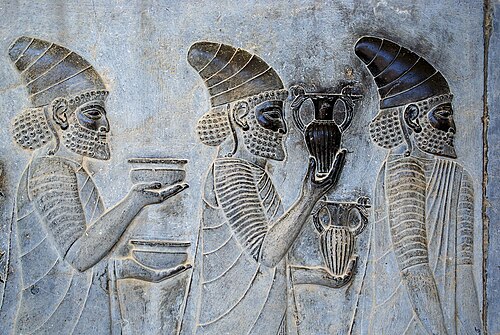
Gift-bearers of one of the twenty-three Apadana delegations at Persepolis, carrying a shallow bowl and handled vessels. The group is usually identified as the Lydians, though Schmidt's report assigned the vessel-bearing delegation to the Syrians; the uninscribed reliefs allow few identifications beyond doubt, and the differing modern labels are themselves part of the evidence's history. Phillip Maiwald (Nikopol) · via Wikimedia Commons · CC BY-SA 3.0 source ↗
What the procession means has proved as contested as who is in it. The older reading took the reliefs as the frozen record of a real annual ceremony, the peoples bringing their New Year tribute; the newer scholarship, led by Margaret Cool Root, reads the programme as ideology, not reportage, "a certain abstract vision of empire and of imperial harmony" rather than the minutes of a festival.[9] Root's larger argument is that Achaemenid art systematically recast the old Near Eastern imagery of domination: where Assyrian versions of the same compositions show captives and coercion, the Achaemenid peoples appear as willing participants, their support of the king staged as cooperation rather than subjection.[9] Whether the objects carried are therefore "gifts" rather than "tribute", and what the difference meant in fiscal fact, is a debate with its own literature (see the Apadana reliefs). However the render is named, the empire chose to portray itself as the sum of its peoples, individuated with an ethnographic care, in dress, hair, beard, footwear and offering, that no one required of a decorative scheme. The frieze is the closest thing that survives to the empire's own illustrated ethnography.
The throne-bearers and the statue
A second sculptural roll is more literal. On Darius's tomb-façade at Naqsh-e Rostam, then on the tombs of his successors and, in shorter files, on palace doorways at Persepolis, thirty figures hold the royal throne-platform aloft, and here the labels survive: "This is the Persian", "This is the Elamite", and so down the whole roll to "This is the man of Maka", each figure in national dress, so that the captions and the costumes together form a labelled atlas of the empire's peoples.[1] Darius points to it himself: the tomb text tells the doubter who wonders how many countries the king held to "look at the sculptures" of the bearers and count.[1] The order of the thirty is not casual; Calmeyer worked out its concentric logic, ring by ring from the Persian centre to the African and steppe periphery (see Naqsh-e Rostam). Kuhrt draws attention to the tenderness of the conceit: the peoples are shown "holding up the royal figure, whose throne platform rests lightly upon the tips of their fingers", effort transfigured into willing, weightless support.[5]
The same programme travelled into other idioms. The statue of Darius found at Susa, carved in Egypt in Egyptian style on the king's own orders, carries on its base the subject peoples in the pharaonic convention, each a kneeling figure with upraised arms inside a fortress-shaped cartouche bearing its name, twenty-four of them, the dahyāva list translated into hieroglyphic form; the same set appears on Darius's stelae from the Suez canal.[5] The statue's cuneiform text states the purpose plainly: whoever sees the monument hereafter is to know that "the Persian man holds Egypt".[5] Wherever the empire spoke of itself, in whatever local language of power, the same grammar recurs: the king above, the named peoples beneath, arranged, labelled and complete.
Herodotus's twenty districts
The first outside answer to the royal lists is Herodotus's account (3.89–97) of how Darius organised his revenue, and it has been fighting the inscriptions ever since. Herodotus reports that Darius divided the empire into twenty "governments", his nomoi, and his interest is explicitly ethnographic as well as fiscal: to build the districts, he writes, Darius "united each nation with its closest neighbours, and, beyond these nearest lands, assigned those that were farther off some to one and some to another nation".[10] There follows the famous ledger, district by district: the first yoking Ionians, Magnesians, Aeolians, Carians, Lycians, Milyans and Pamphylians together at four hundred talents, the rest running east through Babylonia, "the ninth", to India, "the twentieth", the richest of all with its render of gold-dust.[10] The mismatch with the royal rolls is total. The count is twenty against twenty-three or thirty; the groupings cut across the dahyāva; and where, as Briant observes, "in every Achaemenid document the country lists begin with Persia", Herodotus, an Asian Greek writing for Greeks, "begins his list with the Ionian districts".[2] The two kinds of document, he concludes, obey different logics, the royal lists ideological, the Greek list administrative and fiscal, and attempts to collate them item by item are "doomed to failure".[2] How much genuine archival substance lies under Herodotus's ledger, and whether his twenty districts ever existed as administrative units, is a separate question (see the satrapy system). His list is evidence of another kind, the first surviving attempt by an outsider to do what the kings did, enumerate the empire by its peoples.
The edges of his ledger are its most ethnographically interesting entries. Around the tribute-paying core Herodotus sets a fringe of peoples who rendered gifts instead of assessed tribute: the Ethiopians bordering Egypt, whose biennial render of gold, ebony, boys and elephant tusks the ledger itemises; the Colchians of the Caucasus, sending "an hundred boys and as many maidens" every four years; and the Arabs, never conquered at all on his account but "united to them by friendship", having given Cambyses passage into Egypt, who "rendered a thousand talents' weight of frankincense yearly".[10] Whatever the book-keeping reality behind these notices, they preserve a real feature of the empire's texture that the royal lists flatten: a graded periphery of client peoples, bound by arrangement rather than assessment, shading off into the unconquered.
The army catalogue
Herodotus's second catalogue is the muster of Xerxes' invasion army at Doriscus (7.61–99), and it is the longest piece of ethnography the ancient world ever attached to the empire: people after people through the land army, the cavalry and the fleet, each described by dress, armament and commander. It opens with the Persians themselves:
they wore on their heads loose caps called tiaras, and on their bodies sleeved tunics of divers colours, with scales of iron like in appearance to the scales of fish, and breeches on their legs; for shields they had wicker bucklers, their quivers hanging beneath these; they carried short spears, long bows, and arrows of reed, and daggers withal that hung from the girdle by the right thigh
Herodotus 7.61, trans. Godley[10]
The Medes follow, "equipped like the Persians", with the pointed observation that "that fashion of armour is Median, not Persian"; then the roll unwinds eastward and southward through ever stranger gear, Ethiopians wrapped in the skins of leopards and lions, armed with stone-tipped arrows, who "painted half their bodies with gypsum and the other half with vermilion" before battle, a separate people of "eastern Ethiopians" brigaded with the Indians, Thracians in "fox-skin caps".[10] How this catalogue relates to real Achaemenid military practice, and how far its picturesque fringe was ever a fighting force and not merely a parade, is a separate question (see warfare and the army). Two features belong to the peoples' own story. The first is that the catalogue visibly echoes the empire's own genre. Its sequence and its dress-by-dress method run so close to the lists and the sculptured delegations that scholars have long suspected a Persian original behind it, an official order of march or muster-roll; Kuhrt notes that such reviews of "the empire's fighting forces in all their colourful variety" mirror "the royal listing and depicting of subjects".[5] Briant presses the reading further: what Xerxes inspected at Doriscus, on his account, was less a fighting instrument than the ethnic diversity of his subjects, the empire paraded people by people; his verdict is that the occasion was a review of the empire rather than of an army (see Xerxes' invasion of Greece).[2] The second feature cuts the other way. Above the ethnic contingents, Herodotus reports, the commanders were Persians, often royal in-laws and princes; native leadership stopped at the level of costume. The muster displayed the many kinds of men, and displayed just as plainly the one people who commanded them all.[2]
The ruling peoples
The Persians (Old Persian Pārsa) are the empire's authors and its least self-described people, standing where every royal list begins or pointedly declines to begin. They appear in the sculpture as the first of the throne-bearers and the paired escorts of every ceremony, but never among the gift-bringing delegations, and Persia bears no tribute in Herodotus's ledger, an exemption whose fiscal reality is disputed (see the satrapy system).[5][10] What Persians said of themselves survives mainly in the king's own formulae, "a Persian, son of a Persian", and in the spear that "has gone forth far"; the Greek counter-portrait sets against it an ethnography of truth-telling, bow and horse (see Herodotus).[2][1]
The Medes stand second in every list and closer than second in fact: the one subject people whose dress the court adopted for its own ceremonial, whose capital became a royal residence, whose name the Greeks used for the whole empire. Their kingdom, their fall, and the great modern argument over whether a "Median empire" ever existed are a subject in themselves (see the Medes). The empire's own portraiture consistently pairs Mede with Persian, two ruling peoples above the roll of the ruled.[1]
The Elamites, third of the heartland triad, are the empire's quiet partner. Their land, Ūja in the lists, held Susa, one of the great royal seats; their language was the working tongue of the Persepolis administration; their scribal craft ran the heartland's economy. Yet as an ethnic label they nearly vanish inside the machine they operated: in the Persepolis archive, as Henkelman and Stolper have shown, Persians, Medes and Elamites are almost never ethnically tagged, and Tavernier draws the moral that "their ethnicity did apparently not matter for the Persepolis administrators", the labels being reserved for outsiders brought into the heartland.[3] Their trace runs through the Fortification archive and the palaces of Susa.
The subject world
Beyond the Iranian core, the great blocs of the lists can each be given a face. The Babylonians were the empire's richest prize, their land carrying the heaviest silver assessment in Herodotus's ledger; their priesthoods wrote the conquest of 539 into their own theology, and their business houses kept the dated tablets that anchor the whole chronology (see the fall of Babylon and the Cyrus Cylinder). Their two revolts of 484 ended the old line of native kingship (see Xerxes I).[10][4]
The Egyptians, conquered by Cambyses II in the campaign of 525 BCE, are the one subject people whose conquest is narrated in a native voice, the statue-inscription of the collaborating admiral-priest Udjahorresnet; their temples, labour and revolts thread through the whole imperial story, documented more fully than for any other subject people. It was in Egyptian idiom, on the Susa statue and the canal stelae, that the empire's list-making found its most foreign dress.[5]
The Greeks of Asia enter the lists as Yauna, the Ionians, split by the royal scribes into as many as three kinds, "of the mainland", "by the sea", "across the sea", with the "petasos-wearing" Yauna of Europe added after the Balkan campaign, a partition that mirrors no Greek category and is the empire's own ethnography of the Aegean.[1][4] Ionian and Carian craftsmen appear by name in the Susa building charter and Ionian labour-gangs in the Persepolis accounts; in 499 the Ionian cities rose against Persian rule (see the Ionian Revolt).
The Saka of the steppe, one people at Behistun and three by the time of the tomb lists, supplied the empire's picture of its wild north-east. After the campaign of about 519 the captured Saka king Skunkha was added to the Behistun relief behind the row of liar-kings, "identifiable by his tall pointed hat, the marker of certain Saka peoples", the one place where a named foreign king in his national dress enters the royal sculpture.[2] Greek writers, who called all such peoples Scythians, told of Cyrus dying in war against one Saka nation, the Massagetae (see Cyrus the Great).[4]
The Judaeans show what the lists leave out. Too small ever to appear among the dahyāva, they are nonetheless among the best-documented peoples of the empire, through the biblical books of the restoration, Ezra and Nehemiah, and through the Aramaic papyri of the garrison colony at Elephantine in Egypt, with its temple to Yahweh and its correspondence with the satrapal government (see the sources). Their case is the standing reminder that the empire's roll named blocs, not peoples: beneath every entry on the royal lists lay a mosaic of communities the king's stonecutters never had occasion to name.[4]
Around these stand the other great blocs: the Phoenicians, invisible in the lists but the backbone of the imperial fleet in every Greek account; the Arabs, frankincense-bearing friends, never subjects; the Bactrians and Sogdians of the north-east, whose administration was long doubted until the Aramaic documents from Bactria revealed its paperwork; the Indians of Hindush with their gold; the Thracians of Skudra; the Libyans and Ethiopians at the African edge.[10][4]
Rule in practice
How the empire actually governed this diversity is dispersed among the institutional entries, but the pattern the sources yield can be drawn together. Fiscally, the peoples were assessed as lands, with the graded fringe of gift-givers at the margin (see the satrapy system and the daric). Militarily, they were mustered as contingents under Persian command, garrisoned at nodes like Elephantine and Sardis, and settled as military colonists on allotted land (see warfare and the army). Administratively, they moved: the Royal Road and the archive's travel-rations show Egyptians, Babylonians, Cappadocians, Ionians and Indians criss-crossing the empire as workers, envoys and specialists, and the labour force at Persepolis, the kurtaš, was drawn from virtually every subject people, so that the heartland's building accounts read like the lists come to life.[3]
Culturally, the empire's touch was light. It imposed no language, no cult and no dress; it co-opted local elites and left local law and temple alone except where revolt intervened. What it offered instead was a court style, in seals, tableware, dress and manners, that provincial elites adopted because adoption paid. The archaeology of this process is clearest at Sardis, where Dusinberre's studies of seals, mortuary practice and the wine service traced an elite that was neither Persianised nor resistantly Lydian but something new; her general model of the empire, developed from the Anatolian evidence, "conceives of the empire as a web of relations that includes geographic factors but is not determined primarily by locale", with authority and autonomy negotiated group by group rather than radiating from a centre.[11] Her summary of the ideology could stand over the whole subject: "Like the United States motto, Achaemenid ideology emphasizes a sense of e pluribus unum. The imperial ideology emphasizes the unity of many rather than any notion of ethnic identities in isolation."[12]
The peoples' own voices
The final fact about the peoples of the empire is how rarely they speak. The lists, the throne-bearers and the Apadana are the centre's portrait of them; Herodotus's catalogues are an enemy's; and between these two mirrors most of the empire's inhabitants left nothing in their own voice at all. The exceptions are precious and lopsided: Udjahorresnet's self-justifying autobiography; the Judaean garrison's letters from Elephantine; the Babylonian archives, rich but institutional; a scatter of Lydian, Lycian, Carian and Aramaic inscriptions from Anatolia and the Levant. For the Saka, the Bactrians, the Thracians, the Libyans, the men of Maka, there is only what the empire carved and what the Greeks retailed: a costume, a weapon, a tribute-item, a name in three languages. The dress-by-dress ethnography that makes the reliefs and the army catalogue so vivid is also, for people after people, the entire surviving record, and it was composed in every case by someone else. That asymmetry, not any shortage of names, is the real limit of the subject, and the reason the modern literature on the peoples is largely a literature about representations: what can be studied is, first of all, how the empire chose to see them.
Primary sources
The ancient evidence, and what each source attests.
- The lands lists: Behistun (DB §6), DPe, DSe, DNa, XPh
- The empire's own roll of the dahyāva in five versions, 23 to 30 entries: membership, order and even the count shift with conquest and doctrine
- The throne-bearer reliefs and labels (DNe, A?P), Naqsh-e Rostam and Persepolis
- Thirty labelled figures in national dress bearing the royal throne, "This is the Persian", "This is the Mede": the lists translated into a captioned atlas
- The Apadana reliefs, Persepolis
- Twenty-three uninscribed delegations with ushers and gifts, the empire's illustrated ethnography of its peoples; the identifications rest on the labelled throne-bearers and stay partly open
- The statue of Darius from Susa (DSab) and the Suez canal stelae
- The same roll in Egyptian idiom, the peoples kneeling in fortress cartouches beneath the king, made "so that whoever sees it in time to come will know that the Persian man holds Egypt"
- Herodotus, Histories 3.89–97
- The twenty tribute districts: an outsider's enumeration by peoples, Ionian-first where the royal lists are Persia-first, with the gift-giving fringe of Ethiopians, Colchians and Arabs at its edges
- Herodotus, Histories 7.61–99
- The army catalogue at Doriscus: dress-and-weapons ethnography of the ethnic contingents under their Persian commanders; the closest Greek analogue to the royal lists themselves
- The Persepolis Fortification archive: the kurtaš records
- Workers from virtually every subject people rationed in the heartland under ethnic labels; the peoples of the display lists as an administrative and economic reality
How we know
The scholarship of the peoples has been, for a century, a scholarship of representations, and its turning points are readings rather than discoveries. The reliefs came first as records to be decoded, Herzfeld and Schmidt numbering the delegations against the labelled throne-bearers and Walser re-arguing the roster; the decisive shift was Root's study of 1979, which asked not which ceremony the sculpture recorded but what the programme argued, and made the image of willing, cooperative empire the baseline from which work on the material still proceeds.[7][8][9] The inscribed lists travelled the same road, from gazetteers of provincial reform to ideological selections, a re-reading carried by Calmeyer's studies of their inconsistencies and Briant's synthesis; it transferred the administrative question to other evidence and left the mismatch with Herodotus's twenty districts as a fact about genre rather than a contradiction to harmonise, though Jacobs has since re-argued the lists' hierarchy in administrative terms (see the satrapy system).[5][2][3] On the ground, the question moved from cataloguing peoples to asking what imperial rule did to them. The old vocabulary of "Persianization" and its absence, which had made the provinces look untouched because they did not fill with Persian pottery, gave way, after the Achaemenid History Workshops' attack on the elusive-empire problem, to models of negotiated rule, of which Dusinberre's authority-autonomy framework, built on the Sardis and wider Anatolian evidence, is the most developed; the current Companion's regional chapters carry that programme people by people across the empire.[11][5] What would move the subject now is what has always moved it: evidence in the peoples' own hands. The unpublished mass of the Persepolis archive, with its thousands of ethnically tagged workers, the continuing flow of Aramaic documents, and excavation in the eastern satrapies are the likeliest sources of a history of the peoples that is more than a history of their portraits.[3][5]
References
Source key: primary ancient evidence · secondary modern scholarship · consensus an explicitly labelled overview, not a specific citation. Open Source details for the full record.
- ↑ a b c d e f g h i j k l m n o pprimary The royal dahyāva lists and labels in Old Persian: DB §6
Source details
Reference. The royal dahyāva lists and labels in Old Persian: DB §6 (Behistun, the twenty-three lands), DPe §2 (Persepolis), DSe (Susa; the roll restored from the Babylonian version), DNa §§1–4 (the tomb at Naqš-e Rostam), XPh §3 (the daiva inscription), the tomb throne-bearer labels (DNe; Kent's 'DN, minor inscriptions') and their Artaxerxes-era copies (A?P). Translation quoted: Kent 1953, Old Persian: Grammar, Texts, Lexicon
Evidence used. DB §§6–7 (p. 119), DPe §2 (p. 136), DNa §§3–4 (p. 138), the tomb labels (pp. 140–141), the DSe restoration note (p. 142), XPh (pp. 150–152), the A?P labels (p. 156); his renderings and capitalisation kept
- ↑ a b c d e f g h i j k l m n osecondary Pierre Briant 2002
Source details
Reference. Pierre Briant, From Cyrus to Alexander: A History of the Persian Empire (Winona Lake, 2002)
Evidence used. Skunkha added to the Behistun relief, 'identifiable by his tall pointed hat' (p. 127); the lists a selection, the kings 'neither archivists nor historians' (p. 177); the titulature with DPh and the XPh formula (p. 178) and DPg with the diversity of languages and lands (p. 179); Herodotus 1.134 and the centrality of Persia (p. 181); DNa §§1–2 and the Persian-Aryan pedigree (p. 182); Herodotus's list obeying 'a different logic' from the reliefs (p. 185); the Doriscus muster as 'a review of the Empire' and the Persian monopoly of command (p. 197); Herodotus's Ionian-first ordering against the Persia-first royal lists (p. 391)
- ↑ a b c d e f g h isecondary Jan Tavernier 2021
Source details
Reference. Jan Tavernier, 'Peoples and Languages', in B. Jacobs & R. Rollinger (eds.), A Companion to the Achaemenid Persian Empire (Hoboken, 2021), pp. 39–66
Evidence used. the five lands lists tabulated, with entry-counts 23, 25, 27, 29 and 30 (pp. 42–43); vispazana-/paruzana- and the Babylonian rendering 'of all tongues' (pp. 41–42); the multiethnic kurtaš workforce, with Persians, Medes and Elamites untagged because 'their ethnicity did apparently not matter for the Persepolis administrators', after Henkelman & Stolper 2009 (pp. 43–45); ethnically defined groups in Achaemenid royal ideology against their exclusion from the Mesopotamian (p. 46)
- ↑ a b c d e f g hconsensus (flagged) Consensus overview
Source details
Reference. Standard identifications and datings held as represented positions: Skudra as Thrace and the 'petasos-wearing Ionians' as the Greeks of the European coast; Yauna as the chancery's word for Greeks; the three Saka kinds (the hauma-drinking Amyrgians, the pointed-cap tigraxaudā, and those 'across the sea'); Hindush entering the lists c. 518; the absence of the Phoenicians, Cilicians and smaller peoples (the Judaeans among them) from the display lists as a fact of the lists' granularity; the fourth-century Aramaic documents from Bactria (published in the 2000s) attesting the north-eastern administration; Maka generally placed on the Gulf coast; the ethnic naming of the Behistun liar-kings
- ↑ a b c d e f g h i j ksecondary Amélie Kuhrt 2007
Source details
Reference. Amélie Kuhrt, The Persian Empire: A Corpus of Sources from the Achaemenid Period (London, 2007)
Evidence used. ch. 11 introduction: the subject peoples enumerated verbally and depicted 'in their distinctive dress', the throne platform resting 'lightly upon the tips of their fingers', the lists placing Persia (when included) first and Persia absent from the tribute-bearers (p. 470); the army reviews echoing 'the royal listing and depicting of subjects' (p. 472); the statue of Darius from Susa (DSab) with its Egyptian-style base, the subjects in fortress cartouches with upraised hands, and the Tell el-Maskhouta canal-stela parallel (no. 11.2, pp. 477–479 with nn. 14–15); the pointer to Calmeyer 1982–1983 on the 'problems and inconsistencies in the lists of subject lands' (p. 479 n. 17)
- ↑secondary Josef Wiesehöfer 1996
Source details
Reference. Josef Wiesehöfer, Ancient Persia from 550 BC to 650 AD (London, 1996), pp. 29–30
Evidence used. the titulature variants: xšāyaθiya dahyūnām vispazanānām, 'king of the countries containing all races' or 'king of the peoples of every origin', with paruzanānām 'of many races/origins', and 'king on this (great) earth (even far off)'
- ↑ a b csecondary Erich F. Schmidt 1953
Source details
Reference. Erich F. Schmidt, Persepolis I: Structures, Reliefs, Inscriptions (OIP 68; Chicago, 1953)
Evidence used. the procession of 'twenty-three nations', the alternating Persian and Median ushers, and the identification method, 'based on comparisons with the throne-bearers of the tomb reliefs, who are identified by inscriptions' (p. 84); the delegation register: the Medes (no. 1), 'the Armenians?' with stallion and griffin-handled vessel (no. 3), the Babylonians' and Gandarans' humped bulls, the Bactrian camels and the Arabs' dromedary, the Ethiopians' okapi and tusk (pp. 84–90); on the uninscribed reliefs 'only a limited number of nations can be identified beyond any doubt' (p. 117)
- ↑ a bsecondary Julian Degen & Sean Manning 2021
Source details
Reference. Julian Degen & Sean Manning, 'Western Europe', in B. Jacobs & R. Rollinger (eds.), A Companion to the Achaemenid Persian Empire (Hoboken, 2021)
Evidence used. Walser's studies of the Apadana delegations (Walser 1965; 1966) and his edition of Herzfeld's geographical-ethnographic papers, p. 1584
- ↑ a b csecondary Margaret Cool Root 1979
Source details
Reference. Margaret Cool Root, The King and Kingship in Achaemenid Art: Essays on the Creation of an Iconography of Empire (Acta Iranica 19; Leiden, 1979)
Evidence used. the king-and-peoples relationship 'consistently expressed as a cooperative effort of voluntary support of the king by the subject peoples', against the older Near Eastern use of the same compositions (p. 131); the shared Egyptian-Achaemenid preference for 'physically differentiated foreign delegations' as a vision of universal dominion (p. 247); the Apadana as 'a certain abstract vision of empire and of imperial harmony' rather than the record of an actual ceremony (p. 279)
- ↑ a b c d e f g hprimary Herodotus
Source details
Reference. Herodotus, Histories 3.89–97 (the twenty nomoi, the tribute ledger, the gift-giving fringe), 3.88 (the Arabs 'united to them by friendship'), and 7.61–99 (the army catalogue at Doriscus). Translation quoted: A. D. Godley (Loeb)
Evidence used. 3.88 (vol. II p. 115), 3.89 (p. 117), 3.90 (p. 119), 3.92 (p. 121), 3.97 (pp. 125–127); 7.61–62 (vol. III p. 377), 7.69–70 (pp. 381–383), 7.75 (p. 385)
- ↑ a bsecondary Elspeth R. M. Dusinberre 2013
Source details
Reference. Elspeth R. M. Dusinberre, Empire, Authority, and Autonomy in Achaemenid Anatolia (Cambridge, 2013), pp. 2–3
Evidence used. the authority–autonomy model, which 'conceives of the empire as a web of relations that includes geographic factors but is not determined primarily by locale'
- ↑secondary Elspeth R. M. Dusinberre 2021
Source details
Reference. Elspeth R. M. Dusinberre, 'Asia Minor', in B. Jacobs & R. Rollinger (eds.), A Companion to the Achaemenid Persian Empire (Hoboken, 2021)
Evidence used. elite identity over ethnicity in the Anatolian sealstones, and the imperial ideology as 'a sense of e pluribus unum', p. 600
Cite this entry
“The Peoples of the Empire”, in Achaemenica: An Encyclopaedia of the Achaemenid Persian Empire (entry the-peoples-of-the-empire), https://achaemenica.org/articles/the-peoples-of-the-empire, version of 2026-07-24.
Show BibTeX and RIS
@misc{achaemenica-the-peoples-of-the-empire,
  author       = {{Studio Daric}},
  title        = {The Peoples of the Empire},
  year         = {2026},
  howpublished = {\url{https://achaemenica.org/articles/the-peoples-of-the-empire}},
  note         = {Achaemenica: An Encyclopaedia of the Achaemenid Persian Empire. Version of 2026-07-24}
}
TY - ELEC AU - Studio Daric TI - The Peoples of the Empire T2 - Achaemenica: An Encyclopaedia of the Achaemenid Persian Empire PB - Studio Daric PY - 2026 DA - 2026/07/24 UR - https://achaemenica.org/articles/the-peoples-of-the-empire ER -
The article's metadata is embedded on the page, so Zotero, Mendeley and other reference managers detect it automatically.
Corrections and suggestions
Every entry is checked against its sources, but errors and omissions are always possible. If you have found an inaccuracy, or can suggest an improvement, please email a correction. Each note is read and checked against the sources before any change is made.
Related entries
The Persians · The Apadana Reliefs · Tribute & Taxation · The Medes · The Satrapy System · Warfare & the Army · The Achaemenid dynasty · Sardis · The Sources & How We Know · The Elamites · The Saka (Scythians) · The Ionians · The Magi · Herodotus, The Histories · The Behistun Inscription (DB) · Naqsh-e Rostam · Persepolis · Susa · The Persepolis Fortification Archive · Darius I · Xerxes I
Referenced by: Arshama, satrap of Egypt · Artaxerxes III · Babylon · Egypt as a Province · The Conquest of Egypt by Cambyses · The Elephantine Papyri · The King of Kings · The Xerxes Canal
Last updated 2026-07-24.