The great expedition that Xerxes I led against the Greek mainland in 480–479 BCE, the largest single enterprise the Achaemenid Empire ever mounted and the campaign to which the component battles (Thermopylae, Artemisium, Salamis, Plataea, Mycale) belong. The campaign is best taken as a whole: its conception as a royal undertaking, the engineering that most impressed the Greeks (the twin pontoon bridges across the Hellespont and the canal cut through the Athos peninsula), the mustering and the long march, and above all its scale, where the modern demolition of Herodotus' "five million" fixes the credible order of magnitude at a land army of some tens of thousands. Because the campaign survives almost wholly through the patriotic Greek near-monopoly of Herodotus and Aeschylus, the received image of a countless horde punished for its pride is itself the central historiographical problem, and the Persian evidence, thin and non-narrative, tells a different and more limited story.
In the spring of 480 BCE Xerxes, son of Darius and grandson of Cyrus, led out of Asia the largest army and fleet the Achaemenid Empire ever assembled, crossed the Hellespont on two bridges of boats, and marched down through Thrace, Macedonia and Thessaly into the Greek heartland. Within a year his forces had forced the pass of Thermopylae, burned the temples on the Athenian Acropolis, and lost a fleet action in the straits of Salamis; within two, the army left behind under his general Mardonius was beaten and its commander killed at Plataea, and a Persian force destroyed at Mycale across the Aegean. The expedition became, for the Greeks who survived it, the founding event of their history and the archetype of the barbarian horde broken by free men. It is also the single episode of Achaemenid history that the Greek sources report in overwhelming detail, and it is reported almost entirely by them. The campaign belongs together as a single Persian royal enterprise, with the individual battles (Thermopylae, Artemisium, Salamis, Plataea and Mycale) as episodes within it, and the running question is how far the one great surviving narrative can be trusted about an empire that wrote no narrative of its own.
What the sources are, and what they are not
Everything of consequence about the campaign passes through Greek hands. The earliest witness is Aeschylus' tragedy The Persians, produced at Athens in 472 BCE by a dramatist who had himself borne arms against the invasion, which dramatises the defeat from the Persian court's side and fastens on the bridging of the Hellespont as the very emblem of a mortal's hybris against the gods. The fullest is Herodotus, writing a generation later, whose seventh, eighth and ninth books narrate the invasion at length and shape it throughout as the punishment of overreaching pride and the vindication of Greek freedom. Later and far less reliable are Ctesias, Diodorus, Plutarch and others. Against this rich, adverse literary tradition the Persian side sets almost nothing: no royal inscription mentions Greece, and the campaign leaves its trace in the empire's own record only obliquely, in the Persepolis administrative tablets that document the labour and provisioning behind such an enterprise, and in the archaeology of the palaces, which shows no disruption at all through Xerxes' reign. Amélie Kuhrt cautions against the distortion this invites:
Such pieces of evidence help to balance our image of Xerxes' reign, reminding us of the dangers of letting a setback suffered in one campaign along the empire's north-western fringe define an entire reign of twenty-one years.
A. Kuhrt, The Persian Empire, p. 239[1]
The methodological rule follows: Herodotus is indispensable and often superbly informed, but his is a hostile account, to be read as an argument with a shape, not as a neutral record.
Why Xerxes marched: the campaign as a royal enterprise
The received explanation, largely Herodotus', is that Xerxes marched to punish Athens for its part in the Ionian Revolt and the burning of Sardis, and to complete the unfinished business of his father, whose own expedition had been checked at Marathon in 490. Punishment and the extension of the empire westward were certainly proclaimed aims, and Herodotus makes the king announce them in the accents of the Persian habit of conquest:
We never yet have kept quiet since we received this supremacy in succession to the Medes, when Cyrus overthrew Astyages; but God thus leads us, and for ourselves tends to good that we are busied about many things… I carefully considered always how in this honourable place I might not fall short of those who have been before me, nor add less power to the dominion of the Persians.
Herodotus 7.8, trans. Macaulay[2]
The most searching modern reading, John Hyland's, takes this further and inward. For Hyland the decision for a royal campaign, led by the king in person rather than delegated to a general as the earlier Aegean wars had been, had less to do with punitive obligation or strategic fear than with the demonstration of effective kingship through action, in the wake of Xerxes' suppression of the revolts of Egypt and Babylon that had greeted his accession. By retracing and enlarging the marches of Cyrus and Darius, and by crossing more water than his father had crossed, the king positioned himself as worthy of their legacy and capable of exceeding it; the expedition was "both a demonstration of restored imperial unity and world rule... and an act of comparative performance meant to establish his own legacy as the pinnacle of Persian royal achievement."[3] On this account the older idea of a defensive or purely retaliatory Persia, reacting to an Aegean arms race, sits awkwardly with the royal inscriptions' confident claim of universal rule, and misreads a Persian worldview in which the empire was already the centre of the world and a campaign extended, rather than completed, its edges.[3]
The council scenes and the reasons for war
Herodotus does not simply report the decision to invade; he stages it, in a sequence of court scenes that are among the most elaborate set-pieces in his work and among the least reliable as history. The young king resolves on war, is argued out of it by his uncle Artabanus, is driven back to it by a menacing dream, and at last carries the Persians with him. Around this frame move the recurring types of the Herodotean court: Mardonius the reckless favourite who urges the war for his own advancement, Artabanus the prudent elder who counsels against it, and the exiled Spartan king Demaratus, who tells Xerxes the truth about an enemy the king holds cheap. The design is tragic rather than documentary, Herodotus' shaping rather than a record of the court. Artabanus puts the Greek law of overreach into a Persian mouth:
Thou seest how God strikes with thunderbolts the creatures which stand above the rest and suffers them not to make a proud show; while those which are small do not provoke him to jealousy: thou seest also how he hurls his darts ever at those buildings which are the highest and those trees likewise; for God is wont to cut short all those things which stand out above the rest.
Herodotus 7.10, trans. Macaulay[2]
Xerxes answers with the venturer's creed, that a boldness which risks half the feared evils is better than a caution that suffers none[2], and the dream decides the matter. The pattern returns at the Hellespont, where the king surveys the host that hides the water and blackens the shores, "pronounced himself a happy man, and after that he fell to weeping" at the thought that of all that multitude not one would be alive in a hundred years, and Artabanus answers that death is the one refuge from a life so full of grief.[2] The scenes announce the fall before the march has begun.
Because the council is so plainly literary, the historical decision has to be reconstructed around it, and the scholarship stages the question in three overlapping readings. The first takes Herodotus' proclaimed motive, vengeance, at close to face value: the debt owed for the burning of Sardis and the check at Marathon. Revenge is the reason Herodotus supplies for almost every Persian campaign, and it has been read as a Greek gloss, the motive his audience would most readily grant; but Mesopotamian royal ideology did treat the avenging of insult as a genuine and sufficient ground for war, so the vengeance theme may record a real strand of Persian justification rather than only a Greek one.[4] The second reading makes the war a requirement of kingship: a king newly come to the throne, fresh from suppressing the revolts of Egypt and Babylon, had to prove himself by conquest, and Greece was the nearest unconquered ground. In this form, argued by J. M. Cook, George Cawkwell and others, Xerxes "had to conquer something", and the choice of Greece followed from the logic of a monarchy that legitimised each king through his victories.[4] The third reading distrusts the scene itself: Briant and others treat the council debate, and with it the tidy division of motive between a warlike Mardonius and a cautious Artabanus, as a Herodotean construction that cannot recover anything actually said at the Persian court.[5][4]
The readings are less opposed than they appear. Xerxes' own speech in Herodotus already runs the motives together: the Persian custom of ceaseless conquest, the will of the god, the duty to match his ancestors, and a blow against Athens cast as pre-emptive. Those are the same justifications the royal inscriptions and their Assyrian models deploy, so a Greek text and the Persian ideology point the same way. The balance now rests there: the invasion was less the product of a single grievance than the expression of a kingship expected to enlarge the empire and to be seen doing so, of which Hyland's account of the campaign as royal spectacle is the fullest modern statement. What no source provides is a Persian record of a strategic calculation; the "grand strategy" sometimes credited to Xerxes rests entirely on the Greek narrative it claims to correct.[4]
The engineering: the Hellespont bridges and the Athos canal
What impressed the Greeks most, and what they made the material of the king's impiety, were two great works of engineering carried out in the years of preparation. To spare the fleet the passage round the stormy foot of Mount Athos, where an earlier Persian fleet had wrecked in 492, a navigable channel was cut clean through the neck of the Athos peninsula, wide enough for two triremes to row abreast; modern excavation has confirmed its course near the towns of Sane and Acanthus. Herodotus, who reports that the work took three years, names its purpose exactly, and in doing so states the campaign's governing logic:

A modern labelled aerial view of the low isthmus at the head of the Athos peninsula, identifying the course of Xerxes' canal. The marked line is an explanatory overlay, not a surviving open waterway. Konstantinos Tamateas and Pataliputra · via Wikimedia Commons · CC BY-SA 4.0 source ↗
It seems to me, making conjecture of this work, that Xerxes when he ordered this to be dug was moved by a love of magnificence and by a desire to make a display of his power and to leave a memorial behind him; for though they might have drawn the ships across the isthmus with no great labour, he bade them dig a channel for the sea of such breadth that two triremes might sail through, propelled side by side.
Herodotus 7.24, trans. Macaulay[2]
The canal was one part of a much larger programme, spread across Thrace and Anatolia, of broadened roads, stockpiled depots and river bridges, drawing on the same imperial labour dynamics visible in the Persepolis archives; a Treasury tablet records payments to Egyptian, Levantine and Greek workers on palace construction in exactly these years.[6] The second work was the crossing itself. At the narrowest reach of the Hellespont, between Abydos and the far shore, Phoenician and Egyptian engineers flung two bridges of boats, lashed with flax and papyrus cables strained on windlasses, some 674 vessels in all moored head to stream and floored over with timber, brushwood and stamped earth, with screens along the sides so the animals would not shy at the sea.[2] When a storm broke the first attempt, Herodotus reports the act that became the byword for the king's arrogance:
Then when Xerxes heard it he was exceedingly enraged, and bade them scourge the Hellespont with three hundred strokes of the lash and let down into the sea a pair of fetters… 'Thou bitter water, thy master lays upon thee this penalty, because thou didst wrong him not having suffered any wrong from him.'
Herodotus 7.35, trans. Macaulay[2]
The anecdote should be read as it is meant, as a Greek fable of hybris, the yoking of the sacred water like a slave. From the Persian side, as Hyland shows, the bridging and the canal were victories over nature in the old Mesopotamian idiom of royal display, mastery of sea and mountain as a proof of world-rule; the same king who is made to whip the sea is the imperial pathfinder leading his lesser kings across waters no Persian fleet had sailed.[7]
The muster, the march, and the review of the empire
The host gathered in Cappadocia and moved by way of Sardis to the Hellespont; the crossing of the bridges, Herodotus says, took seven days and nights without a break. On the European side, at Doriscus in Thrace, the king held the great review and census that furnishes Herodotus with his famous catalogue of the nations, contingent by contingent, each in its own dress and weapons under a Persian commander. The scene has usually been read as a muster of a fighting army; both Pierre Briant and Hyland read it, more persuasively, as a review of the empire. Most of the forty-seven ethnic contingents Herodotus parades never appear again in his battle narratives, which name only Persians, Medes, Elamites, Saka, Bactrians and Indians; the exotic others, in their skins and feathers, are there for display. Briant draws the conclusion:
Xerxes was not interested in his military forces but in the ethnic and cultural diversity of the peoples of his empire; rather than a review of the troops, this was a review of the Empire.
P. Briant, From Cyrus to Alexander, p. 197[5]
The review embodied in the flesh the lists of subject peoples carved in the royal inscriptions, and its most pointed element, that command of every contingent had passed from native chiefs to Persians, declared that the empire of the Great King was a Persian empire. The mobilisation was thus, in Briant's phrase, a response "to motivations that were more ideological than strategic."[5] Hyland adds the practical corollary: the recruitment burden fell heaviest on Iran and the east for the army and on the Mediterranean seaboard for the fleet, while token delegations from remoter provinces served the needs of symbolic heterogeneity, perhaps drawn from the escorts of the tribute-caravans that converged on the court each year.[8]
The great question of numbers
Herodotus gives the expedition figures that have astonished and misled readers ever since. At Doriscus the land army is tallied at 1,700,000 by the device of penning ten thousand men at a time inside a walled circle:
Of the whole land-army taken together the number proved to be one hundred and seventy myriads: and they numbered them throughout in the following manner: they gathered together in one place a body of ten thousand men, and packing them together as closely as they could, they drew a circle round outside.
Herodotus 7.60, trans. Macaulay[2]
He reserves his climactic arithmetic for the eve of the first storm, adding the fleets and the reinforcements and doubling the combatants to account for the servants, transport-crews and camp-followers:
Thus five hundred and twenty-eight myriads three thousand two hundred and twenty was the number of men whom Xerxes son of Dareios led as far as Sepias and Thermopylai.
Herodotus 7.186, trans. Macaulay[2]
That is 5,283,220 souls, with 1,207 triremes and 3,000 smaller vessels. No modern scholar defends these numbers, and the reasons are not a matter of taste. The correction of the scale is the firmest single result of the modern scholarship. Sean Manning's study of Achaemenid armed force sets the figures against the whole documentary record of the ancient Near East and finds them impossible: both the royal inscriptions and the administrative documents show states that dealt in tens of thousands of soldiers, and neither the Assyrians nor the Persians ever claimed to bring hundreds of thousands, let alone millions, to a battle. The largest army credited to any Near Eastern king in a literary source is the 120,000 that Shalmaneser III boasted of, and few Assyriologists trust even that.[9] Comparison with better-documented periods is decisive:
[C]omparison with later periods suggests that the vast majority of numbers in literary sources are of no value in understanding the size of the armies involved.
S. Manning, Armed Force in the Teispid-Achaemenid Empire, p. 326[10]
Manning points out that solid evidence of gatherings of more than 100,000 soldiers is extremely scarce before the Napoleonic Wars, while the claim of 100,000 or more is everywhere, and that the figures classical writers assign to "barbarians" are estimates made from outside, by men who did not share a language with the enemy's clerks.[10] Even the popular rescue, that Herodotus or his source confused the words for "thousand" and "ten-thousand" and so multiplied the army tenfold, still leaves an army twice as big as the largest known Macedonian and Roman armies.[10]
The credible order of magnitude
The credible scale is recoverable, if only within a range. The most careful scholarship converges on a land army well under 100,000 combatants, and probably far smaller. Hyland, working from the Persepolis ration texts, which fix the daily flour allowance per man and so let the documentary record speak to the numbers, offers a lowest reasonable estimate:
In summary, the lowest reasonable estimate for Xerxes's land army would add up to 50,000 soldiers, 20,000 noncombatants, and at least 30,000 animals.
J. Hyland, Persia's Greek Campaigns, p. 166[8]
Of the fighting men perhaps 14,000 were royal guards and the rest provincial soldiers and conscripts, mostly Iranian, with the cavalry a small fraction of the whole.[8] Kuhrt reaches a comparable figure by the opposite route, reasoning back from the fighting at Plataea:
While the precise numbers of Xerxes' invasion army must remain unknown, it is clear from the only real land battle fought in Greece (Plataea) that the effective fighting force of the Persian army was around 60,000 men.
A. Kuhrt, The Persian Empire, p. 240[1]
The fleet is somewhat less certain, because Aeschylus was an eyewitness at Salamis; Hyland's region-by-region reconstruction, cross-checked against attested later ship-numbers, works from a minimum estimate of about 650 ships rather than Herodotus' 1,207, still large enough to have outnumbered the Greeks.[11] The upshot is a serious correction of scale but not of significance: an army of some tens of thousands, with a fleet of a few hundred ships, was still an enormous undertaking to move and feed a thousand miles from home. The "countless horde" is a literary construction; the real expedition was formidable, finite, and stretched to the edge of what the ancient world could sustain.
Feeding the army
The true measure of the enterprise was set less by how many men Persia could raise than by how many it could feed across a march of a thousand miles, and the preparation the Greeks remembered as engineering was, at root, a problem of supply. In the years before 480 magazines of grain and flour were laid down along the whole line of advance. Herodotus names the depots and Briant lists them: Leuce Acte on the Thracian coast, Tyrodiza in the country of Perinthus, Doriscus, Eion on the Strymon, and Macedonia, each a stocked staging-post on the road the army would take.[5] On the march itself the burden fell on the subjects along the route, who were required to feast the king and his host as it passed, a levy Herodotus reports as the ruin of the towns that bore it. Christopher Hassan, surveying the army's logistics, reads this pairing of pre-positioned depots and requisition as the genuine Achaemenid achievement of the campaign, on a par with the supply systems that moved later armies across comparable distances; the fleet, on his account, was partly there to carry provisions by sea in step with the army on land.[12] The daily ration is also what lets the modern head-counts be checked: Hyland's estimate of the army's size is built from the flour allowance per man in the Persepolis texts, so that a question of numbers becomes a question of tonnage.[8]
The ancient writers grasped the constraint as clearly as the modern ones. In the council Artabanus warns the king that his two most dangerous enemies are not the Greeks but the land and the sea: no country could feed so vast a host for long, and no harbour was large enough to shelter so great a fleet from a storm.[2] The verdict on the campaign has come round to his. What turned Xerxes back was less any one defeat than the impossibility of keeping an army of that size fed through a second and a third season on the far side of the Aegean. The logistics that made the expedition possible also fixed its ceiling.
The campaign and its battles
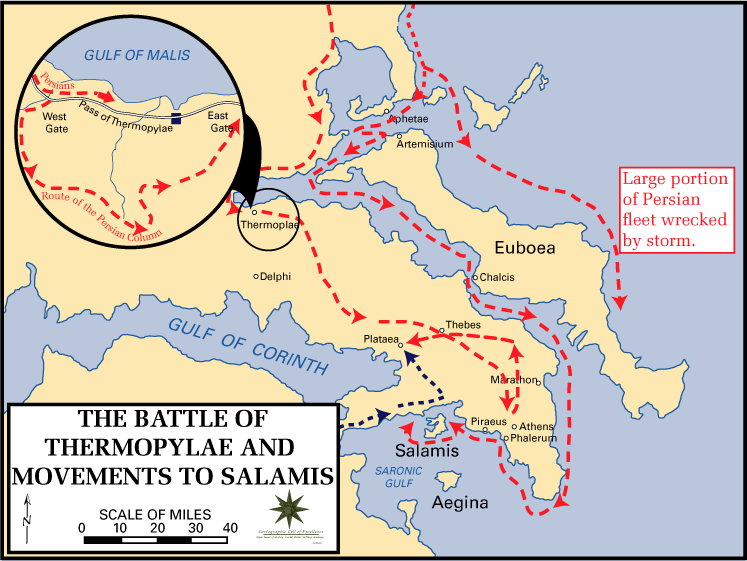
A modern schematic of the 480 BCE campaign from Thermopylae and Artemisium towards Athens and Salamis. The routes, storm loss and positions are conventional reconstructions based chiefly on the Greek literary accounts, not a record of movements known in every detail. Department of History, United States Military Academy · via Wikimedia Commons · Public domain source ↗
Within this frame the famous battles fall into place as episodes of a single westward drive that very nearly succeeded politically before it failed militarily. At the pass of Thermopylae in high summer 480 a Greek force under the Spartan Leonidas held the coastal defile for some days until the position was turned by a mountain path, and was destroyed; the simultaneous naval clashes off Artemisium, indecisive in themselves, cost both fleets and were broken off when the land position fell. The road to central Greece lay open. Here the Persian achievement was as much diplomatic as military: as Kuhrt stresses, the Persians repeatedly and successfully exploited the divisions among the Greek states, so that virtually all of central Greece went over to them, the Peloponnesians retired behind the Isthmus, and Athens was evacuated and its temples burned.[1] The turn came at sea. Drawn into the narrows of Salamis, where their numbers could not tell, the Persian fleet was beaten by the Greek ships while the king watched from a throne on the shore; among his captains that day was Artemisia of Halicarnassus, the one woman to command a squadron in the fleet. Xerxes withdrew to Sardis to direct affairs from there, leaving Mardonius with a picked force, essentially Iranian, to hold Greece over the winter and renew the offensive in 479. When the Athenians, returned to their city after Salamis, refused his offers of alliance, Mardonius marched south again in the summer of 479, occupied the evacuated town a second time, and on withdrawing into Boeotia burned and pulled down what the first sack had spared, so that Athens was destroyed twice within two years.[2] Later that summer Mardonius was defeated and killed at Plataea, the war's one pitched land battle, and on the same reckoning a Persian army was destroyed at Mycale on the Ionian coast. With that the bid to annex Greece was over, and the western frontier settled into intermittent warfare rather than becoming a belt of subject provinces. The received story of the return, a starving and terrified host fleeing through hostile country, Kuhrt notes, is contradicted by the loyalty of Thessaly, Paeonia and Macedon and undermined by Herodotus' own report of an alternative route: it is one of several dramatised endings for the vanquished foe.[1]
The daiva inscription: context, not proof
One Persian text is regularly dragged into the campaign, and it does not belong there without heavy qualification (see Xerxes I). The trilingual proclamation of Xerxes from Persepolis, the so-called daiva inscription, XPh, records that the king put down the worship of the daivas, the false gods, and established the worship of Ahura Mazdā in their place:
And among those countries there were (some) where formerly the daivas had been worshipped. Afterwards by the favour of Auramazda I destroyed that place of the daivas.
Xerxes, XPh §4b, trans. Kuhrt[13]
It has sometimes been read as a report of a specific cultic purge in a rebel land, and by extension linked to the burning of the Athenian Acropolis or to the Babylonian revolts. Both links fail. The text names no shrine and no place; it is a commemorative statement of royal piety, and its own logic, as Kuhrt shows, elaborates Darius' teaching that rebellion against the king is rebellion against the god's order, not a chronicle of any single event.[1] Crucially, the notion that the daiva-sanctuary was a Babylonian temple cannot stand, because it is now established that there is no evidence Xerxes destroyed any Babylonian cult-centre at all.[1][14] The inscription is genuine and important Persian evidence for the ideology within which the reign, and so the campaign, was conceived; it is not evidence for what happened in Greece, and serves only as context for it.
Weighing Herodotus
The campaign is the sharpest test in all Achaemenid history of writing about an empire through its enemies. Herodotus' virtues are real: his catalogue of Persian commanders gives linguistically authentic names, many matching individuals known from the Persepolis archives; his account of the preparations squares with the labour and supply system the tablets document; his geography and his sense of Persian court practice are often sound. His governing purpose, though, is to make the Persian defeat the exemplary punishment of pride, and that purpose bends everything: the numbers swell to a scale of hubris designed "to melt away with the reversals of Xerxes's fortunes,"[8] the king's every triumph is undercut, the Persian military achievement in overcoming Greek resistance and taking Athens is obscured, and divine favour is credited only to the Greek side.[7] Aeschylus, staging the same events eight years after Salamis, gives the pattern its mythic form, the sacrilegious yoking of the Hellespont bringing ruin on the yoker. In the play the ghost of Darius names his son's offence:
He conceived the hope that he could by shackles, as if it were a slave, restrain the current of the sacred Hellespont, the Bosporus, a stream divine; set himself to fashion a roadway of a new order, and, by casting upon it hammer-wrought fetters, made a spacious causeway for his mighty host. Mortal though he was, he thought in his folly that he would gain the mastery over all the gods, aye even over Poseidon.
Aeschylus, Persae 745–750, trans. Smyth[15]
That the two greatest sources are a patriotic history and a victory tragedy is the fact the reader must hold at every point. The Persian evidence cannot supply an alternative narrative, but it can and does contradict specific Greek claims, the millions, the destroyed Babylonian temples, the humiliating rout, and it reframes the whole: not the near-conquest of the world halted by providence, but a large frontier campaign, mounted to display and extend a kingship already claiming universal rule, that reached the limit of its logistics and was turned back at the edge of the map.
The war in Persian memory
On the Persian side the campaign left almost no mark. No royal inscription names Greece, Athens, Salamis or the Hellespont, and the daiva text, the one document sometimes attached to the reign's western wars, in the way of all royal propaganda admits no reverse of any kind; a "Persian version" still in circulation centuries later, reported by Dio Chrysostom, went so far as to deny that Xerxes had ever been defeated.[4] The episode that for the Greeks became the hinge of their history was, in the empire's own memory, a frontier operation that ended without conquest and left the centre untouched. The war looms so large in the record because the side that lost the campaign wrote its history at length, while the side that kept its empire did not think the reverse worth commemorating. That silence is a caution against reading a long and otherwise secure reign, as the Greek tradition did, through its single western defeat.
What the campaign was, and was not
Set in the empire's own scale, the invasion of 480–479 was neither the apocalyptic collision of the Greek imagination nor the ruin of Persia. It cost the empire nothing of its heartland, and its administrative and monumental record shows the state running in good order for a further twenty years. The old verdict, inherited whole from the Greeks, that Salamis began the long Persian decadence depends on the very sources whose bias the modern reassessment has exposed.
Primary sources
The ancient evidence, and what each source attests.
- Herodotus, Histories, Books 7–9
- The one great narrative of the invasion: the council debates over the decision for war, the bridges and the canal, the supply depots along the march, the catalogue of the nations at Doriscus, the famous army figures, and the battles from Thermopylae to Mycale.
- Aeschylus, The Persians (472 BCE)
- The earliest witness: a tragedy staged eight years after Salamis by a poet who fought in the war, dramatising the defeat from the Persian court's side.
- Ctesias, Diodorus and Plutarch
- The later Greek tradition of the invasion, far less reliable than the fifth-century witnesses.
- The daiva inscription of Xerxes (XPh)
- The king's trilingual proclamation from Persepolis on the suppression of the daivas: evidence for the ideology in which the campaign was conceived, not for the campaign itself, which no royal inscription mentions.
- The Persepolis administrative tablets
- The Fortification and Treasury records behind the enterprise: a Treasury tablet pays Egyptian, Levantine and Greek workers in the preparation years, and the ration texts fix the flour allowance per man on which the modern reconstruction of the army's real size rests.
- The archaeology of the canal and the palaces
- Excavation has confirmed the course of the Athos canal near Sane and Acanthus, and the palace sites show no disruption through Xerxes' reign, against the Greek picture of an empire broken by the defeat.
How we know
The campaign is documented almost entirely by hostile Greek sources of superb quality, and the modern task has been to correct for their bias rather than to add new narrative. Aeschylus writes as an eyewitness but in the register of victory tragedy, fastening the whole defeat to the hybris of the bridge-builder; Herodotus, a generation later, is superbly informed but shapes everything to the theme of pride punished and Greek freedom vindicated, and is the source of the notorious army figures (1,700,000 combatants at Doriscus, a grand total of 5,283,220, and 1,207 triremes); the later tradition is far less reliable. The Persian record supplies no counter-narrative, and its near-silence on Greece is itself a datum: the administrative and archaeological evidence can check the Greek story at specific points, not replace it. The central correction concerns the numbers: Sean Manning, Armed Force in the Teispid-Achaemenid Empire (2020), pp. 319–326, sets Herodotus' figures against the whole Near Eastern documentary record and shows that ancient states dealt in tens of thousands of soldiers, never the hundreds of thousands to millions assigned to 'barbarians', and that solid evidence for gatherings above 100,000 is extremely scarce before the Napoleonic Wars; John Hyland, Persia's Greek Campaigns (2025), pp. 154–177, works from the Persepolis ration texts to a lowest reasonable land army of about 50,000 combatants plus 20,000 non-combatants, and a fleet of about 650 ships (pp. 167–170); Kuhrt, following Briant's estimate of c. 60,000 effective fighting men (Briant, From Cyrus to Alexander (2002), pp. 526–528), reaches the same order from the Plataea order of battle. Hyland's larger thesis, that the expedition was conceived as a royal enterprise of kingship, war and spectacle, a demonstration and extension of world-rule after the revolts of Egypt and Babylon rather than a defensive or purely punitive war, is the current leading interpretation of the Persian conception of the campaign (pp. 130–134, 231–289). Briant (pp. 196–199) reads the Doriscus review as a staging of the empire, not a muster of a fighting army, distinguishing a ceremonial 'parade army' from the essentially Iranian combat force. On the reasons for the war, the field divides between taking Herodotus' vengeance motive as a real strand of Persian royal justification and dismissing his elaborate council scene as a literary construction; the prevailing tendency, following the survey of Persian war-justification in the 2021 Companion (ch. 79) and Hyland's monograph, reads the invasion as the act of a kingship expected to enlarge and display the empire rather than as any single grievance or reconstructed grand strategy. The daiva inscription (XPh) is used here only as context for the reign's ideology, not as evidence for the campaign; the once-common link to a destroyed Babylonian temple is excluded by the demonstration (Kuhrt and Sherwin-White 1987; Waerzeggers 2003/4, cited via Kuhrt) that Xerxes destroyed no Babylonian cult-centre. The verbatim Herodotus passages are given in the public-domain Macaulay translation (1890) with book.chapter citations; the XPh text follows Kuhrt's translation of the Old Persian. The received 'decline' reading of the campaign, and the countless-horde image on which it rests, is now widely taken as a construction of the victors' sources rather than a settled fact.
References
Source key: primary ancient evidence · secondary modern scholarship · consensus an explicitly labelled overview, not a specific citation. Open Source details for the full record.
- ↑ a b c d e fsecondary A. Kuhrt 2007
Source details
Reference. A. Kuhrt, The Persian Empire: A Corpus of Sources from the Achaemenid Period (London, 2007; one-vol. ed. 2007), ch. 7 'The Reign of Xerxes'
Evidence used. the single-episode-over-a-21-year-reign caution; the c. 60,000 effective fighting force (following Briant); the successful Persian exploitation of Greek divisions and the discredited rout narrative; the daiva inscription read as an elaboration of the loyalty ideology, and the demonstration (Kuhrt and Sherwin-White 1987; Waerzeggers 2003/4) that Xerxes destroyed no Babylonian cult-centre; the single-episode caution quoted from p. 239, the c. 60,000 effective fighting force at p. 240 (2007 pagination)
- ↑ a b c d e f g h i j kprimary Herodotus
Source details
Reference. Herodotus, Histories 7.8 (the decision for war, 'we never yet have kept quiet'), 7.10 (Artabanus's warning that the god's bolt strikes the highest), 7.24 (the Athos canal, 'a love of magnificence and... a desire to make a display of his power'), 7.35 (the scourging of the Hellespont), 7.36 (the construction of the two pontoon bridges), 7.44–46 (the review at Abydos, the king's weeping, and Artabanus on death as the refuge from life), 7.49 (the land and the sea as the host's two greatest enemies), 7.50 (Xerxes's venturer's creed), 7.60 (the counting of 170 myriads by the pen of ten thousand), 7.118–120 (the ruinous levy on the peoples along the line of march), 7.184–186 (the grand total of 5,283,220), 9.3 and 9.13 (Mardonius's second occupation and burning of Athens in 479)
Evidence used. quoted verbatim in the public-domain G. C. Macaulay translation (1890)
- ↑ a bsecondary J. O. Hyland 2025
Source details
Reference. J. O. Hyland, Persia's Greek Campaigns: Kingship, War, and Spectacle on the Achaemenid Frontier (Oxford, 2025), pp. 130–134
Evidence used. the campaign as a demonstration of effective kingship and comparative performance against paternal legacy, not a defensive or purely punitive war; the argument against a Persian 'defensive imperialism' at odds with the royal inscriptions' claim of universal rule
- ↑ a b c d esecondary 'Legitimization of War' 2021
Source details
Reference. 'Legitimization of War', in B. Jacobs & R. Rollinger (eds.), A Companion to the Achaemenid Persian Empire (Hoboken, 2021), ch. 79, pp. 1144–1147
Evidence used. the three readings of Xerxes's decision surveyed and weighed: vengeance as a genuine strand of Persian (and older Mesopotamian) royal justification and not merely a Greek gloss; the requirement that a new king prove himself by conquest ('he had to conquer something': Cook, Cawkwell, Evans, Sancisi-Weerdenburg); the council scene as a possible Herodotean invention (Briant, Cawkwell, Evans); Herodotus's Xerxes running the royal-ideological motives together (Hdt. 7.8a); and the 'Persian version' denying any defeat, reported by Dio Chrysostom (11.149)
- ↑ a b c dsecondary P. Briant 2002
Source details
Reference. P. Briant, From Cyrus to Alexander: A History of the Persian Empire (Winona Lake, 2002), pp. 196–199
Evidence used. the Doriscus review as a staging of the empire rather than a muster of a fighting army ('this was a review of the Empire'); the distinction between the ceremonial 'parade army' and the essentially Iranian combat force, since most of Herodotus's 47 contingents never fought; the pre-positioned grain and flour depots for the expedition (Leuce Acte, Tyrodiza, Doriscus, Eion, Macedonia) at p. 157 (from Herodotus 7.25); the council debate on the decision for war treated as a Herodotean construction at pp. 158–159
- ↑secondary J. O. Hyland 2025
Source details
Reference. J. O. Hyland, Persia's Greek Campaigns (2025), pp. 132–134
Evidence used. the Athos canal and the wider Thracian/Anatolian infrastructure programme; the Persepolis Treasury tablet (PT 15) recording payments to Egyptian, Levantine and Greek workers in 483/482; Isserlin's excavation of the canal
- ↑ a bsecondary J. O. Hyland 2025
Source details
Reference. J. O. Hyland, Persia's Greek Campaigns (2025), pp. 231–233
Evidence used. the crossings of sea and mountain as Mesopotamian-style victories over nature and proofs of world-mastery; Herodotus's undercutting of each royal showpiece and his crediting of divine favour only to the Greek side
- ↑ a b c d esecondary J. O. Hyland 2025
Source details
Reference. J. O. Hyland, Persia's Greek Campaigns (2025), pp. 154–166
Evidence used. the demolition of Herodotus's numerical exercise; the lowest reasonable land army of 50,000 soldiers, 20,000 non-combatants and 30,000 animals, reconstructed from the Persepolis ration texts; the royal guards (Spear-Bearers / 'Immortals') and the recruitment burden on Iran and the east
- ↑secondary S. Manning 2021
Source details
Reference. S. Manning, Armed Force in the Teispid-Achaemenid Empire: Past Approaches, Future Prospects (Stuttgart, 2021), pp. 70–71
Evidence used. both the royal inscriptions and the documents show Near Eastern states dealing in tens of thousands of soldiers; the largest literary army (Shalmaneser III's 120,000) is distrusted, and no Assyrian or Persian source claims hundreds of thousands of soldiers at a battle
- ↑ a b csecondary S. Manning 2021
Source details
Reference. S. Manning, Armed Force (2021), pp. 323–326
Evidence used. the conclusion that 'the vast majority of numbers in literary sources are of no value in understanding the size of the armies involved'; solid evidence for gatherings above 100,000 is extremely scarce before the Napoleonic Wars; the 'thousand/ten-thousand confusion' rescue still leaves an impossible army; estimates of barbarian armies are made from outside
- ↑secondary J. O. Hyland 2025
Source details
Reference. J. O. Hyland, Persia's Greek Campaigns (2025), pp. 167–170
Evidence used. the region-by-region reconstruction of the fleet to a lowest conceivable total of about 650 ships, against Herodotus's 1,207, cross-checked with attested later ship-numbers
- ↑secondary C. Hassan 2021
Source details
Reference. C. Hassan, 'Structure of the Army and Logistics', in B. Jacobs & R. Rollinger (eds.), A Companion to the Achaemenid Persian Empire (Hoboken, 2021), ch. 80, p. 1158
Evidence used. the Achaemenid supply system on the Greek campaign: the depots of food, water and fodder stocked along the route (Herodotus 7.25), the heavy requisition of supply from the peoples passed through (Herodotus 7.118–120), the fleet's part in carrying provisions by sea, and the Engels principle that supply requirements governed an army's movements
- ↑primary The daiva inscription
Source details
Reference. The daiva inscription (XPh), Persepolis
Evidence used. Xerxes on the suppression of the daivas and the worship of Ahura Mazdā ('I destroyed that place of the daivas... The daivas shall not be worshipped any longer!') — quoted verbatim in Kuhrt's translation of the Old Persian (Kuhrt 2007, no. 7.88); used here as context for the reign's ideology, not as evidence for the campaign; the translation verified at p. 305 of the 2012 one-vol. ed. (XPh §4b)
- ↑secondary C. Waerzeggers 2018
Source details
Reference. C. Waerzeggers, 'Introduction: Debating Xerxes' Rule in Babylonia', in C. Waerzeggers & M. Seire (eds.), Xerxes and Babylonia: The Cuneiform Evidence (Orientalia Lovaniensia Analecta 277; Leuven, 2018)
Evidence used. the dismantling of the Xerxes-the-destroyer picture and her 'end of archives' reading of 484 (the widespread abandonment of Babylonian archives 'a by-product of targeted reprisals against supporters of the rebellions'), pp. 3–5; the standing position that 'there is no evidence for destruction of Babylonian cities and temples in the wake of the revolts', p. 5; the daiva inscription 'not usually read historiographically anymore', p. 2 n. 4
- ↑primary Aeschylus
Source details
Reference. Aeschylus, Persae 745–750 (the ghost of Darius on his son's yoking of the Hellespont)
Evidence used. quoted verbatim in the translation of H. W. Smyth (Loeb, 1926)
Cite this entry
“Xerxes' Invasion of Greece (480–479 BCE)”, in Achaemenica: An Encyclopaedia of the Achaemenid Persian Empire (entry xerxes-invasion-of-greece), https://achaemenica.org/articles/xerxes-invasion-of-greece, version of 2026-07-23.
Show BibTeX and RIS
@misc{achaemenica-xerxes-invasion-of-greece,
  author       = {{Studio Daric}},
  title        = {Xerxes' Invasion of Greece (480–479 BCE)},
  year         = {2026},
  howpublished = {\url{https://achaemenica.org/articles/xerxes-invasion-of-greece}},
  note         = {Achaemenica: An Encyclopaedia of the Achaemenid Persian Empire. Version of 2026-07-23}
}
TY - ELEC AU - Studio Daric TI - Xerxes' Invasion of Greece (480–479 BCE) T2 - Achaemenica: An Encyclopaedia of the Achaemenid Persian Empire PB - Studio Daric PY - 2026 DA - 2026/07/23 UR - https://achaemenica.org/articles/xerxes-invasion-of-greece ER -
The article's metadata is embedded on the page, so Zotero, Mendeley and other reference managers detect it automatically.
Corrections and suggestions
Every entry is checked against its sources, but errors and omissions are always possible. If you have found an inaccuracy, or can suggest an improvement, please email a correction. Each note is read and checked against the sources before any change is made.
Related entries
The Xerxes Canal · Xerxes I · Mardonius · Darius I · Herodotus, The Histories · Aeschylus, Persae (The Persians) · The Battle of Thermopylae (480 BCE) · The Battle of Salamis (480 BCE) · The Battle of Plataea (479 BCE) · The Battle of Mycale (479 BCE) · Warfare & the Army · The King of Kings · The Royal Road · The Satrapy System · Cyrus the Great · The Persepolis Fortification Archive
Referenced by: Artemisia I of Halicarnassus · Atossa · Darius III · Sardis · The Immortals · The Saka (Scythians)
Last updated 2026-07-23.