The Apadana reliefs are the sculptured façades of the two great stairways of the Apadana, the audience hall of Persepolis: files of Persian and Median guards, courtiers and royal grooms on one wing and, on the other, twenty-three delegations of subject peoples, each in the costume of its land, each led by the hand towards the centre with offerings of metalwork, cloth, weapons and animals. Planned under Darius I and carved chiefly under Xerxes, they are the largest sculptural programme of the Achaemenid empire and the image through which it is now most often seen. The programme is as remarkable for what it omits as for what it shows: no battle, no captives, no kneeling or roped figures, no heaped spoil, and no name-labels on any delegation. Where Assyrian palace art staged empire as conquest, the Apadana staged an ordered, willing world in procession, and the meaning of that staging is the principal quarrel in the study of Achaemenid art. Older scholarship read the frieze as the record of a real ceremony, most elaborately as a New Year festival at the spring equinox, a theory now largely abandoned; the reading argued by Margaret Cool Root, and broadly followed since, takes it as an idealised image of empire as gift-bearing partnership rather than a record of any single occasion. Because the delegations are unlabelled, their identification rests on dress, gifts and animals matched against the inscribed throne-bearers of the royal tombs, and several attributions remain disputed. The original centrepieces, two panels of the enthroned king receiving a bowing official, were cut out in antiquity and reburied in the Treasury, where the excavators found them; which king they show, and why they were removed, is still argued. The eastern stairway, buried under fallen mud brick and uncovered only in the 1930s, preserves the sculpture almost as it left the carvers' hands.
The two stairways
Two monumental stairways climb the terrace front of the Apadana at Persepolis, one on the north and one on the east, each a pair of flights set against a sculptured façade more than eighty metres long. The scholarly name is a convenience, borrowed from the audience hall of Susa, where the word apadāna is actually attested; at Persepolis it conventionally denotes this audience hall and its stairways (for the building, the terrace and their history, see Persepolis). The two façades carry one programme twice over. "Each of the two stairways shows essentially the same scenes", Schmidt reported, but in mirror image: "Thus the reliefs on one stairway show the opposite sides of the persons depicted in the reliefs on the other stairway."[1]
An accident of decay decided which version the modern world knows. The northern façade stood open to the air for over two millennia; the eastern lay under a deep bed of collapsed mud brick until Ernst Herzfeld's excavation in the early 1930s:
The sculptures of the northern stairway, exposed for many centuries to the elements and to vandalism and pilfering, have often been described. The eastern stairway, discovered by Herzfeld, had fortunately been protected and preserved by a thick layer of mud-brick debris.
Schmidt, Persepolis I, p. 82[1]
Nearly every photograph, cast and textbook figure of "the Apadana reliefs" therefore shows the eastern stairway, whose burial kept the carving crisp to the fingernails. Herzfeld "planned a comprehensive treatment of the reliefs of the tribute procession, which was apparently in preparation at the time of his death", and it never appeared; the base description remains Erich Schmidt's excavation volume of 1953, whose notes "are based mainly on the infinitely better preserved reliefs of the eastern stairway".[1]
Darius's hall, Xerxes's reliefs
The hall itself is Darius's: his gold and silver foundation tablets lay beneath its corners, and the building was under way by about 515 BCE (see Darius I). The staircase reliefs are another matter. The trilingual inscription on each façade is a text of Xerxes, XPb, and it names no builder except himself:
Says Xerxes the great king: What was built here by me and what was built elsewhere by me, all this I have built by the grace of Ahuramazda. May Ahuramazda protect me with the gods and my kingdom, and what was built by me.
Xerxes I, XPb §3, trans. Weissbach[2]
Schmidt drew the chronological inference that has held ever since:
The omission in the stairway inscriptions of any reference to Darius' building activities suggests that the stairways were constructed during the reign of Xerxes and leaves little doubt that their reliefs were executed during his time.
Schmidt, Persepolis I, p. 82[1]
"It has been suggested for stylistic reasons that the reliefs of the northern stairs are somewhat earlier than those on the east", he added.[1] The design, however, is generally placed under Darius, since the audience panels later found in the Treasury were cut for these façades and belong stylistically to his reign (see below). The programme is thus best understood as a Darius conception carried out, and signed, by his son; the same divided credit runs through Xerxes's building texts across the terrace (see Xerxes I).
The design of the façades
The centre of each façade is a panel of soldiers: "two antithetic groups of four alternating Persian and Median guards", standing rigidly at attention, each lance grounded on the forward foot.[3] The Persians wear the fluted tiara and the flowing pleated gown Schmidt calls the candys; the Medes a domed hat, belted coat, trousers and short sword. These central guards are themselves ancient replacements; the panels they superseded showed the enthroned king. Above them a winged disc hovers between two human-headed, bull-eared sphinxes with the square-tipped beard of royalty and divinity (on the disc and its disputed meaning, see the winged symbol). In the triangular spandrels at either side, "the triangular panels flanking the central groups of guards each show a rearing bull attacked by a lion", beneath a terraced row of cypresses.[3] Soldiers continue wherever the architecture offers a surface: pairs of Persian lancers on the newels, files armed with lance, bow and quiver along the inner faces of the parapets just above the steps, so that a visitor climbing the flights passed between carved guards before emerging in front of carved courtiers.[3]
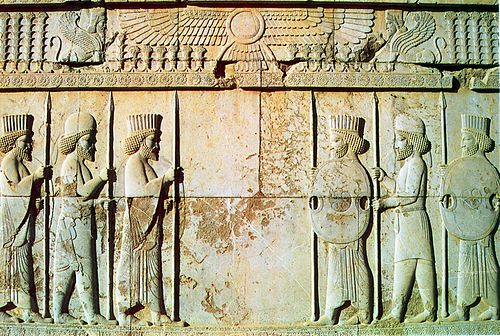
The centre of an Apadana façade: the winged symbol hovering between two human-headed, bull-eared sphinxes above a file of Persian guards in fluted tiaras and, at right, guards with round shields. These central guard-orthostats are themselves ancient replacements, refitted after the enthroned-king audience scene first carved here was cut out and removed. Grey limestone carved in the reign of Xerxes; the warm tone is the weathered stone, its original paint long gone. Arad Mojtahedi · via Wikimedia Commons · CC BY-SA 3.0 source ↗

Persian and Median nobles on the eastern stairway, alternating fluted tiara and round cap, several turning to touch hands or shoulders in the informal gestures Schmidt read as a relief from the frieze's formalism. Along the top border runs the royal-stable register, where the wheel of one of the two empty chariots is visible. Eastern stairway, carved under Xerxes; the surface is cracked but crisply preserved. Wouter Bontenbal · via Wikimedia Commons · CC BY-SA 3.0 source ↗
The wings flanking this centre carry the two processions, each disposed in three superimposed bands:
The main portion of the sculptured area is subdivided into three long horizontal panels, or registers, bordered by rosette frames and filled with rows of rather monotonous reliefs. In each register lines of guards (43 in the upper register, 28 in the middle, 21 in the lower) precede the other participants in the festival depicted.
Schmidt, Persepolis I, p. 82[1]
On one wing the guards are followed by the court. In the top register comes the royal stable: ushers with staffs, attendants carrying whips and fringed saddle-cloths, one with the king's footstool strapped to his back, then three led horses and two small two-horse chariots, driven but empty.[4] Below file thirty-two dignitaries, Persians and Medes alternating; "A Persian has precedence in each case."[5] These nobles are the one informal note in the whole composition:
A pleasant change from the monotonous formalism of the other reliefs is provided by the unconventional postures of most of the other dignitaries; looking backward in many cases and obviously meant to be chatting with one another, they are shown holding hands or touching one another's shoulders or equipment in gestures of comradery.
Schmidt, Persepolis I, p. 83[5]
Root reads the same figures as projecting "an impression of a rather mannered courtly intimacy".[4] Some of the guard files, distinguished by twisted fillets, have been taken for Elamite (Susian) troops, and Schmidt allowed that they "may represent a unit of the elite corps, the 'Immortals'" (see the Immortals).[5] One absence is total: "No woman is represented in the Apadana reliefs or in any of the other sculptures of the Achaemenid buildings and tombs at Persepolis and Naqsh-i-Rustam."[5]
The file of the nations
The balancing wing belongs to the subject peoples: in Schmidt's words, "a procession of twenty-three tribute-bearing delegations of the empire".[1] Each delegation is a self-contained unit of three to nine figures. A Persian or Median usher, staff in hand, leads the delegation's chief by the hand; behind follow attendants with the offerings, vessels balanced on shoulders, folded garments over arms, animals on leads. "Each unit is set off from the next by a tree", Root observes, and "the trees are aligned with one another vertically, so that the units of figures are in effect set into a grid formed by trees and horizontal rosette borders".[6] The effect is a tabular composition, an empire laid out in cells, walking. Within the cells the carving distinguishes the nations down to small things: the six-strapped boots of the Elamites, the long hanging tip of the Babylonian hat, a Bactrian ear-pendant, the tasselled corners of an Ionian scarf, the serrated edge of a Libyan cape.[7] The precision is what makes the identification game possible at all, and it implies pattern-books of some kind behind the chisels, whether drawings, garments or memory.

Schmidt's delegation 2, the Elamites (Susians): figures in twisted fillets and pleated gowns lead a snarling lioness by a rope, a cub following below. The block is broken by a horizontal fracture and the lower register is damaged, but the animal group reads clearly. Eastern stairway, early fifth century BCE. A. Davey · via Wikimedia Commons · CC BY 2.0 source ↗
In what order the cells were meant to be read is a real question. "There has been much debate about the order in which the tribute groups were meant to be 'read'", horizontally register by register, or vertically in columns of three; Root accepted the vertical reading "because it yields a list which agrees with that given by the platform carriers on the east door of the Central Building of Darius", against the horizontal order preferred by Muscarella and Barnett, while Herzfeld, Schmidt, Walser, Hinz and Tilia had likewise numbered vertically.[6] Read either way, the sequence matches no surviving country-list of the royal inscriptions: "Western and eastern peoples are arranged in a pattern for which scholars have not yet understood a rationale."[6] The procession is a counterpart of the inscribed lists of lands and of the labelled throne-bearers, and the fullest statement of that whole genre in any medium (see the peoples of the empire for the lists and their ideology); but it is a composition in its own right, and it keeps its own order.
Naming the nations
No figure on either stairway carries a label. Every ethnic name attached to a delegation is a modern inference, and the reliefs' apparatus of identification is one of the more instructive episodes of Achaemenid scholarship. The key is the royal tombs at Naqsh-e Rostam and Persepolis, where the throne-bearing figures who support the king's platform are individually captioned in cuneiform; dress, headgear, footwear and weapons could be matched from the captioned tomb figures to the uncaptioned staircase ones. Delegations "not recognizable or not represented in the tomb reliefs" were then "tentatively identified by Herzfeld" from their gifts and animals, with further proposals from the young Julius Junge.[8] The method's limits show in Schmidt's own punctuation: fourteen of his twenty-three entries end in a question mark. The identifications also moved under the excavators' feet: the delegation published as Arachosian in 1933 became the Parthians(?) of the final report.[8] Gerold Walser's monograph of 1966 subjected every attribution to a fresh examination, and handbooks still differ over several groups.[9]

Schmidt's delegation 12, taken as Ionians (Greeks of western Anatolia): bare-headed men in wavy woollen gowns carrying bowls, folded cloth and rounded skeins of wool or yarn. Herzfeld read the same group as Lydians, and because the Ionian and Lydian throne-bearers of the royal tombs are nearly identical, the attribution is one of the frieze's classic cruxes. Eastern stairway, carved under Xerxes. Carole Raddato · via Wikimedia Commons · CC BY-SA 2.0 source ↗
The twenty-three delegations
Schmidt's catalogue, building on Herzfeld's scheme, runs as follows; the question marks are Schmidt's own, and part of the evidence.[7]
- 1. The Medes: domed felt hats, belted coats, a short sword at the leader's side; a pitcher and bowls, heavy rings, folded coats and trousers.
- 2. The Elamites (Susians): pleated Persian gowns and twisted fillets; two bows tipped with ducks' heads, sheathed daggers, and a snarling lioness led on a rope while two attendants carry her cubs.
- 3. The Armenians (?): Median dress; a bridled stallion and a great two-handled vessel with griffin grips. The dress differs between the two stairways, an inconsistency Schmidt flags.
- 4. The Arians (?) (of Haraiva, Herat): Median coats, heads wrapped in the bashlyk (a hood-like cloth cap); bowls, a feline skin, a two-humped Bactrian camel.
- 5. The Babylonians: fringed robes and conical hats with hanging tips; bowls, draped cloth, a humped zebu bull.
- 6. The Syrians: long woollen gowns; amphorae with handles ending in winged bulls, ornamented armlets, and a two-horse chariot whose axle-pin is carved as the Egyptian dwarf-god Bes. Most later accounts, including the British Museum's 2005 catalogue, call this delegation the Lydians.[10]
- 7. The Arachosians (?): Median coat and bashlyk; bowls, a camel, a feline skin.
- 8. The Cilicians (?): fillets and sashed gowns; bowls, skins, cloth, and a pair of rams.
- 9. The Cappadocians (?): bashlyks with muffler flaps, capes fastened by a pin; a stallion and garments.
- 10. The Egyptians: long ribbed gowns, barefoot; cloth and a bull. The upper half of the eastern relief is lost.
- 11. The Saka Tigraxauda, the "pointed-hat Scythians": tall pointed caps, and every member armed, with swords and the leader's bow-case; a stallion, rings, garments.
- 12. The Ionians (?): wavy woollen gowns, bareheaded; ribbed metal cups and bowls, folded cloth, and conical hanks of wool or yarn. The classic crux: Herzfeld read this delegation as the Lydians (see below).
- 13. The Parthians (?): Median coats, baggy trousers; bowls and a Bactrian camel.
- 14. The Gandarians (?): capes over bare legs; a humped bull, lances and a round shield. Herzfeld ended by calling them Sattagydians.
- 15. The Bactrians (?): fillets and Median coats; fluted bowls and a Bactrian camel.
- 16. The Sagartians (?): Median hat and coat; garments and a stallion. Herzfeld thought instead of a Caucasus people.
- 17. The Sogdians (?): caps with ear-flaps, and armed; a sword with a crescent pommel, rings, battle-axes, a stallion.
- 18. The Indians: bare torsos, skirts and sandals; baskets holding jars of gold-dust, battle-axes, and a donkey, "a strong well built donkey and not an onager" on the zoologist Bryan Patterson's inspection.
- 19. The Skudrians (?) (Thracians): pointed ear-flap caps and capes; lances, a shield, a stallion.
- 20. The Arabians (?): long robes; folded cloth and a one-humped dromedary. Oriental Institute records suggested the Macians instead.
- 21. The Drangians (?) (of Zranka): fillets, scarves and Median coats; a lance and shield and a long-horned bull.
- 22. The Libyans (Putāyā): capes with serrated edges; an antelope with twisted horns and a chariot.
- 23. The Ethiopians (Kušiyā): skirts and scarves; a lidded vessel, an elephant tusk, and the exotic animal Schmidt recorded as an okapi.
The gifts sometimes answer the written record: the Indians' gold-dust matches Herodotus's report that India paid its enormous tribute in gold-dust, and the animals map the empire's fauna from zebu to dromedary.[11] Sometimes they answer nothing that survives, and the beasts themselves have been argued over: Patterson judged the Ethiopians' animal "a member of the giraffe family", like an okapi in most respects, and one later study makes it a giraffe outright.[12][13]
The contested identifications
Four cruxes show how the label-less method strains. The twelfth delegation, bareheaded gown-wearers with cups, cloth and wool, sits on the classic fault-line: Schmidt, in tentative agreement with Junge, took them for the Ionians of western Anatolia, while "Herzfeld identifies them with the Lydians", and the difficulty is structural, since on the tomb reliefs the Ionian throne-bearer is nearly indistinguishable from the Lydian.[14] The twenty-first delegation collects three claimants: Schmidt catalogued the group as Drangian with his question mark, Herzfeld leant towards the Margians of Merv, and "Junge identifies the tribute-bearers under consideration with the Lydians", making a second Lydian candidacy in one procession.[14] The fourteenth wavers between Gandarians and Sattagydians, two adjacent Indus-frontier peoples whose throne-bearers dress alike. And of the armed seventeenth Schmidt conceded that "there is a possibility that this delegation may represent the Saka Haumavarga, rather than the Sogdians".[14] None of these disputes has been closed; the 2005 British Museum catalogue still labels one group "Probably Parthians, or Bactrians".[10] What is secure is the principle of the array rather than every name in it: distinct peoples, distinctly dressed, each bearing the signature produce of a quarter of the earth.

Schmidt's delegation 6, which he catalogued as Syrians but which most later accounts call the Lydians: the leader draws one of a pair of small horses for a two-wheeled chariot, while his fellows bring handled vessels, ring-cups and armlets. Eastern stairway, early fifth century BCE; the sharp modelling is that of the long-buried eastern façade. Carole Raddato · via Wikimedia Commons · CC BY-SA 2.0 source ↗
An empire without violence
Set beside the imperial art it descends from, the procession is defined by subtraction. Assyrian palace reliefs render subject peoples under the lash and the yoke: files of prisoners, severed heads, cities burning, tribute flung down before a colossal king. Root's study of the programme's ancestry places the Apadana in that compositional tradition and shows the tradition reversed:
These Achaemenid sculptures stand in stark contrast to a Near Eastern tradition which also makes use of the basic representational structure of the king above figures symbolic of his domain in order to express a succinct vision of imperial ethos and hierarchy.
Root, King and Kingship, pp. 131–132[15]
The older tradition, she continues, rendered that relationship "as one of antagonism"; the Achaemenid version renders it as support freely given.[15] The Egyptian ancestry makes the same point from the other side. Theban tomb paintings of the Eighteenth Dynasty parade foreign delegations, Nubians, Syrians, Aegeans, in native dress with native goods, and Egyptologists have long recognised that these scenes ideologically recast diplomacy and trade as submission, complete with prostrate chiefs and registrars tallying the take. The Apadana keeps the delegation-by-nation format and deletes the humiliation: no scribes counting, no goods piled in heaps, no one on the ground.[16] Root reads the result as a deliberate statement: empire portrayed as a voluntary partnership of crown and peoples, composed to suggest a solemn, almost sacral compact between them.[15]
The contrast runs inside Achaemenid art as well. At Behistun, Darius stands with his foot on a fallen rival while nine rebel leaders wait roped at the neck: coercion carved without embarrassment, where the subject is rebellion. The Apadana, addressed to the obedient empire rather than to its enemies, admits no rope and no foot on anyone; the two monuments divide the work of imperial imagery between punishment and concord, and the division looks like policy.[17]
The delegates' own bearing is the strongest card in that argument:
The general demeanor of the foreign delegates, combined with the fact that some of them are shown to wear their weapons, indicates that they were meant to be understood as non-belligerent, willing participants in the ceremony shown to be taking place.
Root, King and Kingship, p. 235[18]
The Saka and Sogdian delegations walk armed into the king's presence, swords at their belts. In a Near Eastern audience scene that detail is extraordinary, and it is difficult to read as anything except trust displayed on purpose. Whether the harmony pictured corresponded to the empire experienced is a separate question; the reliefs are evidence for the empire's self-presentation, and Briant's caution holds that neither the sculpted peoples nor the inscribed lists were meant as administrative documentation, both serving instead as vehicles of the idea of royal power.[19]
Tribute, gifts, or covenant
What exactly is being handed over? The older literature called the scene a tribute procession and assumed a yearly ceremony of render behind it. Root's examination of the Greek and visual evidence complicated both halves of that assumption:
Herodotus does not mention any actual tribute ceremony which would correspond to what is portrayed on the Apadana relief. Here, representatives of virtually all the subject nations are shown bringing tribute. Conspicuously absent are men from Persia itself. … Yet the figures on the Apadana relief are bringing gifts which are suggestive not of an annual taxation, but, rather, of a symbolic encomium
Root, King and Kingship, pp. 230–231[20]
The absence of Persis is the telling detail. Herodotus reports that Persia alone was exempt from assessed tribute, and the reliefs agree: no Persian delegation brings goods.[11] Had the designers wished to carve the fiscal machine, its exempt centre would have been no obstacle; what they carved instead was a homage of characteristic gifts, the kind of symbolic offering Persians themselves could in principle have made. The British Museum's exhibition catalogue chose its noun accordingly, describing "files of Persian and Median nobles, and twenty-three delegations from all around the empire bringing presents to the great king".[10] Greek writers distinguished assessed tribute (phoros) from gifts (dora); how the distinction worked in fiscal practice, and how far the king's own word for tribute swallowed both, is a separate question (see tribute and taxation). The goods themselves lean the same way: the delegations carry no grain, no silver by weight, none of the bulk staples the administrative tablets show the empire actually moving, but the signature crafts and beasts of their lands, closer to heraldry than to bookkeeping.[20] On the staircase the question is ideological, and there the balance of scholarship now sits with Root: the procession renders the idea of the empire's render, willing, ordered and perpetual, rather than any one year's receipts.
The New Year theory and its collapse
For much of the twentieth century a stronger claim held the field: that the reliefs document an actual festival. A line of scholars culminating in Roman Ghirshman tied the procession to the Iranian New Year, Nowruz, at the spring equinox; "Ghirshman also reads the reliefs as an illustration in stone of an elaborately choreographed No Ruz procession", as Root summarises, and L'Orange explored an astral-kingship version of the same idea, while Krefter's reconstruction of the terrace went so far as to plot, in Root's words, "a week's worth of No Ruz ceremonies in and among the buildings".[21] The theory animated a whole picture of Persepolis as a ritual city inhabited once a year (see Persepolis for that larger debate and its own demolition).
Root, drawing on Carl Nylander's work, dismantled the reading on two independent grounds. The first is evidential: "we know next to nothing about the No Ruz festival during the Achaemenid Period", and the elaborate festival reconstructions are retrojections from sources such as al-Bīrūnī, more than a millennium later.[22] The second is physical, and was argued for the closely related throne-bearing scenes: Nylander stressed "the impossibility of negotiating a large podium and throne through the extremely awkward passageways" of the buildings on whose jambs they are carved; the architecture fights the ceremonies imagined on its walls, and Root's Apadana-specific point stands beside it.[22] Root's verdict, that "the sculptures can no longer be taken as literal illustrations of specific ceremonies", is now the standard position, with her fair-minded coda that some ceremony of gift-giving may well have happened somewhere on the terrace; the stones simply do not record its choreography.[22] The collapse of the festival reading strengthened the ideological one: once the reliefs stop transcribing an event, their want of any datable occasion reads as intended, an image of the empire's homage valid on any day of any year.[22]
The missing king
As excavated, the processions converge on files of guards; the king they were composed to approach is missing. That is the result of an ancient revision. Two large relief panels found by Schmidt's expedition, reburied in the Treasury, show the lost scene: the Great King enthroned before two incense burners, sceptre in hand, receiving a dignitary who bows slightly with his hand before his mouth, the crown prince standing behind the throne. Ann Britt Tilia's examination during the Italian conservation campaign demonstrated where they belonged: in the Cambridge Ancient History's words, "these reliefs were not intended for the Treasury, but rather were originally set in the centre panels of the stairways to the Apadana".[23][24] At some date the panels were prised out, carried across the terrace and reburied, and the staircase centres refitted with the present orthostats of guards flanked by the lion-and-bull groups; in the British Museum catalogue's summary, the audience scenes were "removed in antiquity and replaced by panels showing a lion attacking a bull".[10][25]

The relocated central panel, now in the National Museum of Iran, Tehran: the Great King enthroned with sceptre and lotus before two incense-burners, an official bowing with his hand raised before his mouth, the crown prince behind the throne. Cut for the centre of an Apadana stairway, the two audience panels were prised out in antiquity and reburied in the Treasury, where Schmidt's expedition found them. Whether the enthroned figure is Darius I or Xerxes with his murdered heir Darius remains disputed. Photographed at an oblique angle behind glass. Radosław Botev · via Wikimedia Commons · CC BY 3.0 PL source ↗
Who sits on the throne? Schmidt read Darius I enthroned with Xerxes as crown prince, and "Bruno Jacobs agrees with Schmidt's identification of the enthroned king as Darius I and of the standing figure as Xerxes".[25][26] Tilia's findings opened the rival case, put by Shahbazi: the enthroned figure "is probably Xerxes, and the crown prince standing behind him is his eldest son named Darius", the heir "who was murdered together with his father and did not reign" in the palace conspiracy of 465 BCE.[27][25] On that reading the relocation acquires a motive. "The removal of the panels from a position of honour and public view is thus explained as an act of Artaxerxes I", the surviving son who took the throne over his murdered brother's claim and had no wish to display him carved as heir; the Cambridge Ancient History presents the reconstruction as attractive rather than proven, and the identification remains open (see Xerxes I for the dynastic crisis and this crux within it).[24]
Whatever the motive, the excision rewrote the programme. The enthroned king was the grammatical object of the entire composition, the figure towards whom every usher led every delegation; with the panels gone, a scene of audience became a parade towards nothing in particular, and the alteration is a rare case of an imperial image edited in antiquity, with the edit itself surviving (see Persepolis for the panels' later history in the Treasury).[25]
The lion and the bull
The lion felling a bull fills the triangular panels of the central façade, as on every major stairway of the terrace, and after the revision it also occupied the Apadana's centre. The group is among the most reproduced images of Persian art: the lion's claws hooked into the bull's haunch, the bull's head wrenched back, the whole struggle compressed into the triangle's geometry. What it meant has never been established. The oldest proposal is calendrical. Herzfeld noted the pairing of zodiacal beasts:

A lion bringing down a bull, set in the triangular panel of an Apadana staircase within its stepped, crenellated frame; after the audience panels were removed, groups like this also occupied the façades' centres. Among the most reproduced of Persian images, its meaning is undeciphered: calendrical, Zoroastrian and generally apotropaic readings have all been proposed, and no Achaemenid text explains it. In situ, weathered. Yong Woo Park · via Wikimedia Commons · CC BY 4.0 source ↗
Since lion and bull are figures of the zodiac and since they are apparently associated—at least on the building under consideration—with the celebration of the Iranian New Year (coinciding with the spring equinox), Herzfeld suggests that this scene has astronomical meaning.
Schmidt, Persepolis I, p. 83[3]
On this reading Leo overtakes Taurus as spring overtakes the rains, a cosmic New Year in stone. A sharper theological variant has been proposed: the group "may have a more precise Mazdaean significance, referring to the assault of the evil spirit Akoman on the embodiment of Good Purpose (and cattle), Vohu Manu".[28] Neither interpretation is demonstrated. Root does not supply a third solution for this motif: her statements that combat scenes "bear no particular relationship to the Iranian New Year's ritual described for other periods" and carry "a more generalized apotropaic significance" concern the royal hero fighting creatures, not the lion-and-bull group. Extending that reading to the animal pair would be analogy, not direct evidence.[29] No Achaemenid text identifies the scene. Calendrical and Mazdaean readings remain unproven proposals; an apotropaic extension would require separate evidence.
Foreign hands, royal design
The documentation places the terrace works inside a pan-imperial labour system, but it does not identify every hand on the Apadana. Darius's foundation charter for Susa names Lydians and Ionians among the craftsmen involved in building that palace.[30] At Persepolis, the administrative evidence attests manual workers and craftsmen (kurtaš) "recruited from all over the empire to serve the king in Fars" (see the Persepolis Fortification tablets, and Persepolis for the labour system).[31] Together these sources establish cosmopolitan royal construction, not the ethnic composition of this façade's carving team. Nylander's studies of tool marks, above all the toothed chisel, traced Ionian stone-working technique at Pasargadae and after, giving the textual picture a technical comparison.[32]
How much the foreigners contributed beyond hands has been argued in both directions. Ann Farkas's 1974 study staked the maximal claim:
The view will be taken that foreign sculptors, including Greeks, were employed at the Persian court during the time of Darius and subsequent rulers, and that the custom of using foreign artisans had begun in Cyrus' reign.
Farkas, Achaemenid Sculpture, p. 7[32]
These sculptors, largely Greek in her account, "incorporated Greek techniques and stylistic details into the sculptural programs probably dictated by the Great King".[32] The position reads today as a dated maximalism: since Root and Nylander the emphasis has fallen on the coherence of the result, a new imperial style that no single contributing tradition can claim, designed from the centre and executed by whoever the empire could summon. Michael Roaf's study of the Apadana's repetitive carving used the complex set of sculptors' marks to reconstruct specialised workshops and their division of labour across the façade.[33] Even Farkas's own clause concedes the direction of control, and the inscriptions clinch it: Rüdiger Schmitt observes that the stonemasons who cut the royal texts "did not possess such knowledge since they were merely copying their text from a draft", reproducing a scribe's exemplar errors and all.[34] Foreign chisels, royal cartoon: the reliefs are Persian art made by the empire's many hands.
Colour and completion
The grey stone the visitor sees is a ghost. "One of Herzfeld's letters to the Oriental Institute mentions that traces of pigments were found 'everywhere at the sculptures which had been buried under the soil'", Schmidt reports, and concludes:
we must conclude that all stairway sculptures had been painted. It is unknown whether the whole surface of the gray limestone reliefs was colored or whether the background between the figures was left unpainted.
Schmidt, Persepolis I, p. 82 n. 90[35]
"Traces of paint have been recorded since Texier's visit in 1844", Mousavi notes, reminding his readers that "these reliefs were all painted".[36] The proof of the wider polychrome programme now extends beyond the terrace: inspection of the Egyptian-made statue of Darius in Tehran "revealed that the statue was painted", its folds in a reddish brown, with samples taken to establish whether the pigments were Persian or Egyptian work.[37] A full pigment analysis of the staircase reliefs themselves remains a desideratum; for the palette recovered elsewhere on the terrace, Egyptian blue among it, see Persepolis. The delegations, in short, once advanced in colour, painted dress against painted ground, and the modern monochrome is an accident of weathering.
The programme was also never quite finished. On the eastern stairway "parts of the rosette decoration were left unfinished in several instances", and unfinished work is a signature of the terrace at large, whose abandoned Unfinished Gate, in Mousavi's phrase, "is a remarkable workshop for restorers where different phases of the working of the stone and the carving of reliefs can be studied".[1][36] Tilia's study of working methods reconstructed the sequence, from blocked-out forms to final polish, that the unfinished patches freeze in mid-step.[23]
After antiquity
The eastern stairway's burial, probably by collapsed mud-brick superstructure after the fire of 330 BCE, sealed it (for the burning and the site's later history, see Persepolis). The reliefs had already led a mobile life within the terrace's own antiquity: fragments of tribute-bearer reliefs, with a Babylonian inscription naming Artaxerxes I, were found re-set in a later palace-front on the central hill associated with Artaxerxes III, quarried from an earlier building and recombined.[38] The excavation era added its own displacement: in November 1934 Herzfeld presented the visiting Swedish crown prince, without authorisation, with a relief fragment of a guard from the Apadana's eastern stairway, an episode that fed his forced departure and Schmidt's succession to the directorship.[38]
Photography completed what excavation began. Schmidt's expedition photographed the freshly cleared eastern façade panel by panel, and published aerial views of the terrace, and those Oriental Institute plates became the source of the empire's modern image: the gift-bearing procession is now the visual shorthand for Achaemenid Persia on book covers, banknotes and museum walls. The image has been re-used as deliberately as it was made. At the Pahlavi monarchy's celebration of 2,500 years of kingship at Persepolis in 1971, "Thousands dressed up as ancient Medes and Persians" paraded below the terrace, a modern state re-enacting the stone procession as its own pedigree.[39] The reliefs' first purpose, an ordered world walking willingly towards its king, has proved serviceable to more monarchies than the one that carved them.
Primary sources
The ancient evidence, and what each source attests.
- The Apadana staircase reliefs, Persepolis
- the monument itself: the eastern façade nearly intact from its ancient burial, the northern weathered by exposure; the two carry the same programme in mirror image.[17][1]
- The relocated audience panels (the 'Treasury reliefs'), National Museum of Iran, Tehran
- the original centrepieces: the enthroned king, crown prince and bowing dignitary, cut from the staircases in antiquity and found reburied in the Treasury.[17][25]
- XPb, the stairway inscription of Xerxes
- the only text on the monument: Xerxes claims the building without naming Darius, the basis for dating the carving to his reign.[2][1]
- The inscribed throne-bearers of the royal tombs (DNa and successors), Naqsh-e Rostam and Persepolis
- the identification key: the only Achaemenid reliefs whose peoples carry name-labels, against which the unlabelled delegations are matched by dress and gear.[8]
- The Persepolis Fortification and Treasury tablets
- the documentary control on the labour system: manual workers and craftsmen recruited from across the empire to serve the king in Fars.[31]
How we know
The evidentiary boundary is unusually sharp. The two stairway façades survive, one buried and well preserved, the other long exposed; the displaced audience panels survive in Tehran; and XPb names Xerxes but no ceremony, delegation or iconographic programme.[17][2][1] Because the delegations carry no captions, their names, order and occasion remain modern inferences grounded in comparison with the labelled tomb figures.[8]
Schmidt's Persepolis I (1953) remains the descriptive base and its pp. 84–90 the catalogue from which later identifications begin.[1][7] Walser reopened the ethnic attributions without closing the Ionian/Lydian and related cruxes.[9] The larger interpretive shift came with the rejection of a literal Nowruz procession: the festival is not attested for the Achaemenid period, and the proposed route does not fit the buildings.[22] Root's alternative, an idealised image of voluntary imperial cooperation rather than a record of a single ceremony, remains the central reading, while the archive supplies a control against mistaking ideology for administration.[15][19]
Study of the fabric has changed the account as much as iconography. Tilia established the audience panels' original place and reconstructed stages of carving; Roaf used repetitive forms and marks to investigate specialised workshops; pigment reports secure a lost polychromy even though the staircase palette is incompletely analysed.[23][33][35][37] The panels' royal identities remain unresolved: Darius with Xerxes, or Xerxes with the murdered prince Darius. The Artaxerxes-I removal theory depends on the latter identification and remains an explanation, not a fact.[25][24][27] The lion and bull is likewise undeciphered; Root's apotropaic discussion concerns royal-hero combat and cannot be transferred to the animal pair as direct evidence.[29]
References
Source key: primary ancient evidence · secondary modern scholarship · consensus an explicitly labelled overview, not a specific citation. Open Source details for the full record.
- ↑ a b c d e f g h i j k lsecondary Erich F. Schmidt 1953 — pp. 82–84
Source details
Reference. Erich F. Schmidt, Persepolis I (OIP 68, Chicago, 1953), pp. 82–84
Evidence used. the mirrored stairway programmes and preservation contrast; the Xerxes-period dating from the stairway inscriptions; three registers, guard counts and twenty-three delegations; and unfinished rosette carving.
- ↑ a b cprimary XPb
Source details
Reference. XPb — Xerxes I, Persepolis, inscription b (the Apadana stairway inscription, Old Persian with Elamite and Babylonian versions). Translation quoted: F. H. Weissbach, as printed in Schmidt, Persepolis I (OIP 68, Chicago, 1953), pp. 82–83 — §3 'Says Xerxes the great king: What was built here by me and what was built elsewhere by me, all this I have built by the grace of Ahuramazda. May Ahuramazda protect me with the gods and my kingdom, and what was built by me'; the text names Xerxes alone, without reference to Darius's building
- ↑ a b c dsecondary Erich F. Schmidt 1953 — p. 83
Source details
Reference. Erich F. Schmidt, Persepolis I (OIP 68, Chicago, 1953), p. 83
Evidence used. the central Persian and Median guards, winged symbol and sphinxes, lion-and-bull spandrels, and Herzfeld's astronomical interpretation reported in n. 99.
- ↑ a b c dsecondary Erich F. Schmidt 1953 — pp. 83–84
Source details
Reference. Erich F. Schmidt, Persepolis I (OIP 68, Chicago, 1953), pp. 83–84
Evidence used. the royal-stable train and thirty-two alternating Persian and Median dignitaries, their gestures of comradeship, the possible elite 'Immortals', and the absence of women from the monumental reliefs.
- ↑ a b csecondary Margaret Cool Root 1979 — pp. 234–235
Source details
Reference. Margaret Cool Root, The King and Kingship in Achaemenid Art (1979), pp. 234–235
Evidence used. the trees and rosette borders forming a grid; the horizontal-versus-vertical reading debate; and the sequence's failure to match a known inscription list.
- ↑ a b c dsecondary Erich F. Schmidt 1953 — p. 84; p. 88 n. 135
Source details
Reference. Erich F. Schmidt, Persepolis I (OIP 68, Chicago, 1953), p. 84 and p. 88 n. 135
Evidence used. identifications matched to labelled tomb figures, tentative assignments by Herzfeld and Junge, and the revision of a group first published as Arachosian to Parthian(?).
- ↑ a bsecondary Gerold Walser 1966 — the monograph on the delegation identifications
Source details
Reference. Gerold Walser, Die Völkerschaften auf den Reliefs von Persepolis (Teheraner Forschungen 2, Berlin, 1966)
Evidence used. the standard delegation-by-delegation study of the identifications, and a vertical-order reader in the reading-order debate
Source caveat. Walser's monograph is not held; it is cited through Root 1979, p. 235 nn. 11–12, and its role is reported from there.
- ↑ a b c dsecondary John Curtis & Nigel Tallis (eds.) 2005 — pp. 35, 60–62
Source details
Reference. John Curtis & Nigel Tallis (eds.), Forgotten Empire: The World of Ancient Persia (London, 2005)
Evidence used. the accessible synthesis: 'files of Persian and Median nobles, and twenty-three delegations from all around the empire bringing presents to the great king', and the central panels 'removed in antiquity and replaced by panels showing a lion attacking a bull' (p. 35); the cast catalogue labelling delegation VI 'Lydians', XII 'Ionians' and XV 'Probably Parthians, or Bactrians' (pp. 60–62)
- ↑ a b cprimary Herodotus
Source details
Reference. Herodotus, Histories 3.89–97
Evidence used. the tribute catalogue of Darius: India's tribute paid in gold-dust (3.94), and Persia alone exempt from assessed tribute (3.97); the fiscal counterpoint to the reliefs, which show gold-dust among the Indians' gifts and no Persian delegation
- ↑secondary Erich F. Schmidt 1953 — pp. 89–90 nn. 150, 162
Source details
Reference. Erich F. Schmidt, Persepolis I (OIP 68, Chicago, 1953), pp. 89–90 nn. 150 and 162
Evidence used. Patterson's identification of the Indians' animal as a donkey rather than an onager, and the Ethiopians' animal as a member of the giraffe family.
- ↑secondary Margaret Cool Root 1979 — p. 235 n. 10
Source details
Reference. Margaret Cool Root, The King and Kingship in Achaemenid Art (1979), p. 235 n. 10
Evidence used. bibliography for the separate interpretation of the Ethiopian delegation's animal as a giraffe.
- ↑ a b c dsecondary Margaret Cool Root 1979 — pp. 131–132
Source details
Reference. Margaret Cool Root, The King and Kingship in Achaemenid Art (Acta Iranica 19, Leiden, 1979), pp. 131–132
Evidence used. the programme's governing thesis: the king–peoples relationship in Achaemenid art consistently expressed as voluntary, cooperative support, its imagery composed to suggest a sacral covenant; the sculptures 'stand in stark contrast to a Near Eastern tradition' using the same king-over-subjects structure to express the relationship 'as one of antagonism' (the fuller passage is quoted, for the tomb throne-bearers, in the Darius I article)
- ↑secondary Margaret Cool Root 1979 — pp. 240–242
Source details
Reference. Margaret Cool Root, The King and Kingship in Achaemenid Art (Acta Iranica 19, Leiden, 1979), pp. 240–242
Evidence used. the Egyptian ancestry of the delegation composition: the Eighteenth-Dynasty Theban tomb paintings (Rekh-mi-Re; the Punt reliefs) parading foreign delegations while ideologically recasting trade and diplomacy as submission and tribute; the Achaemenid designers' retention of the nation-by-nation format with the submission apparatus (prostration, tallying, heaped goods) removed
- ↑ a b c dprimary The Apadana staircase reliefs themselves
Source details
Reference. The Apadana staircase reliefs themselves
Evidence used. the eastern and northern stairway façades in situ at Persepolis, and the two relocated audience panels (the 'Treasury reliefs') now in the National Museum of Iran, Tehran; with, for the internal contrast of punishment and concord, the Behistun relief (DB) and its roped rebel leaders; the primary evidence throughout
- ↑secondary Margaret Cool Root 1979 — p. 235
Source details
Reference. Margaret Cool Root, The King and Kingship in Achaemenid Art (1979), p. 235
Evidence used. the delegates' demeanour and worn weapons as signs of non-belligerent, willing participation.
- ↑ a bsecondary Pierre Briant 2002 — p. 183
Source details
Reference. Pierre Briant, From Cyrus to Alexander: A History of the Persian Empire (Winona Lake, 2002), p. 183
Evidence used. neither the country lists nor the depictions of peoples are intended as a realistic picture of administration or geography; both are vehicles of the idea of royal and imperial power (the passage is quoted verbatim in the tribute-and-taxation article; paraphrased here)
- ↑ a bsecondary Margaret Cool Root 1979 — pp. 230–231
Source details
Reference. Margaret Cool Root, The King and Kingship in Achaemenid Art (Acta Iranica 19, Leiden, 1979), pp. 230–231
Evidence used. the gifts-not-taxation argument: 'Herodotus does not mention any actual tribute ceremony which would correspond to what is portrayed on the Apadana relief'; 'Conspicuously absent are men from Persia itself', agreeing with Herodotus 3.97 on the Persian exemption; the offerings 'suggestive not of an annual taxation, but, rather, of a symbolic encomium' such as the Persians themselves might have offered
- ↑secondary Margaret Cool Root 1979 — p. 156
Source details
Reference. Margaret Cool Root, The King and Kingship in Achaemenid Art (Leiden, 1979), p. 156
Evidence used. Root summarises Ghirshman's choreographed Nowruz procession, L'Orange's astral-kingship variant and Krefter's week of ceremonies among the terrace buildings.
- ↑ a b c d esecondary Margaret Cool Root 1979 — pp. 156–157
Source details
Reference. Margaret Cool Root, The King and Kingship in Achaemenid Art (Leiden, 1979), pp. 156–157
Evidence used. Achaemenid Nowruz is virtually undocumented, and a podium and throne could not negotiate the awkward passages. The sculptures are not literal records of a specific ceremony, though ceremony somewhere on the terrace remains possible.
- ↑ a b csecondary Ann Britt Tilia 1972 — Studies II, pp. 175–208
Source details
Reference. Ann Britt Tilia, Studies and Restorations at Persepolis and Other Sites of Fārs (IsMEO, Rome, 1972–1978)
Evidence used. the demonstration, during the Italian conservation campaign, that the audience panels found in the Treasury had been cut for and originally set in the central panels of the Apadana staircases (Studies II, pp. 175–208), and the study of Achaemenid working methods that reconstructs the carving sequence from the unfinished portions
Source caveat. Tilia's volumes are not held; her findings are cited through Mousavi 2012, pp. 18–20, which gives the page references.
- ↑ a b csecondary Boardman 1988 — p. 77
Source details
Reference. The Cambridge Ancient History, vol. IV (2nd ed., Cambridge, 1988), p. 77
Evidence used. the Treasury Reliefs 'For some time … were thought to show Darius on his throne with Xerxes behind him as crown prince'; the re-examination showing 'these reliefs were not intended for the Treasury, but rather were originally set in the centre panels of the stairways' to the Apadana; and the erasure reconstruction: 'The removal of the panels from a position of honour and public view is thus explained as an act of Artaxerxes I', suppressing the memory of the murdered crown prince Darius — offered as an attractive explanation rather than a proven one
- ↑ a b c d e fsecondary Ali Mousavi 2012 — pp. 18–20, 53
Source details
Reference. Ali Mousavi, Persepolis: Discovery and Afterlife of a World Wonder (Berlin, 2012), pp. 18–20 and 53
Evidence used. the central-panel dossier: Schmidt's discovery of the audience reliefs in the Treasury, Tilia's demonstration of their Apadana origin, and the staircase modifications (pp. 18–20 with nn. 27–28, 50); the king-identity dispute reported with both camps ('Bruno Jacobs agrees with Schmidt's identification of the enthroned king as Darius I and of the standing figure as Xerxes', n. 51; Shahbazi's case that the king 'is probably Xerxes' with the murdered crown prince Darius behind, n. 52); the removal as changing the meaning of the staircase programme (p. 53, after Sancisi-Weerdenburg and Tilia)
- ↑secondary Jacobs 1997 — pp. 295–296
Source details
Reference. Bruno Jacobs, 'Eine Planänderung an den Apadana-Treppen und ihre Konsequenzen für die Datierung der Planungs- und Bebauungsphasen von Persepolis', Archäologische Mitteilungen aus Iran 29, pp. 295–296
Evidence used. the defence of Schmidt's identification of the enthroned king as Darius I with Xerxes as crown prince
Source caveat. Jacobs's article is not held; his position is cited through Mousavi 2012, p. 20 n. 51.
- ↑ a bsecondary A. Shapur Shahbazi 1976 — pp. 151–156
Source details
Reference. A. Shapur Shahbazi, 'The Persepolis Treasury reliefs once more', Archäologische Mitteilungen aus Iran N.F. 9 (1976), pp. 151–156
Evidence used. the case, built on Tilia's findings, that the enthroned figure 'is probably Xerxes' and the standing heir 'his eldest son named Darius, who was murdered together with his father and did not reign', with the panels' removal assigned to Artaxerxes I
Source caveat. Shahbazi's article is not held; his argument is cited through Mousavi 2012, p. 20 with n. 52.
- ↑secondary Axworthy 2008 — fig. 1 caption
Source details
Reference. Michael Axworthy, Iran: Empire of the Mind (London, 2008), fig. 1 caption
Evidence used. the lion-and-bull group as normally read for Nowruz, spring replacing winter at the equinox, 'But it may have a more precise Mazdaean significance, referring to the assault of the evil spirit Akoman on the embodiment of Good Purpose (and cattle), Vohu Manu'
- ↑ a bsecondary Margaret Cool Root 1979 — p. 307
Source details
Reference. Margaret Cool Root, The King and Kingship in Achaemenid Art (Acta Iranica 19, Leiden, 1979), p. 307
Evidence used. the sceptical corrective on the combat imagery: following Nylander, the Achaemenid hero-combat reliefs 'bear no particular relationship to the Iranian New Year's ritual described for other periods'; the motif carries 'a more generalized apotropaic significance', the king as heroic archetype protecting his domain from creatures symbolising hostile forces
- ↑secondary Meier 2021 — ch. 45
Source details
Reference. Mischa Meier, 'The Greek World', in B. Jacobs & R. Rollinger (eds.), A Companion to the Achaemenid Persian Empire (Chichester, 2021), ch. 45
Evidence used. 'Lydians and Ionians are named as craftsmen who were involved in the building of the palace of Susa' in Darius's foundation inscription, with Greek contributions to the design and construction of Persepolis
- ↑ a bsecondary Wiesehöfer 2021 — ch. 2
Source details
Reference. Josef Wiesehöfer, 'Demoscopy and Demography', in B. Jacobs & R. Rollinger (eds.), A Companion to the Achaemenid Persian Empire (Chichester, 2021), ch. 2
Evidence used. the kurtaš as manual workers and craftsmen 'recruited from all over the empire to serve the king in Fars'; the labour force behind the terrace works
- ↑ a b csecondary Ann Farkas 1974 — p. 7
Source details
Reference. Ann Farkas, Achaemenid Sculpture (Nederlands Historisch-Archaeologisch Instituut te İstanbul, 1974), p. 7
Evidence used. the maximalist statement of the foreign-sculptor thesis: foreign sculptors including Greeks employed at the Persian court from Cyrus's reign onward, who 'incorporated Greek techniques and stylistic details into the sculptural programs probably dictated by the Great King'; Nylander's toothed-chisel evidence for Ionian technique is discussed in the same study
- ↑ a bsecondary Michael Roaf 1983 — via Companion chs. 93–94
Source details
Reference. Michael Roaf, Sculptures and Sculptors at Persepolis (Iran 21, 1983)
Evidence used. the repetitive Apadana scenes as products of specialised workshops, and sculptors' or masons' marks as evidence for organising relief labour; reported through the held 2021 Companion, chapters 93–94.
Source caveat. Roaf's study is not held; the specialised-workshop finding and the use of marks to reconstruct labour organisation are cited through the held 2021 Companion, chapters 93–94.
- ↑secondary Schmitt 2021 — ch. 104
Source details
Reference. Rüdiger Schmitt, 'The Achaemenid Empire and Forgery: Inscriptions', in B. Jacobs & R. Rollinger (eds.), A Companion to the Achaemenid Persian Empire (Chichester, 2021), ch. 104
Evidence used. the stonemasons who engraved the genuine royal texts 'did not possess such knowledge since they were merely copying their text from a draft'; the carvers as executants of a scribal exemplar
- ↑ a bsecondary Erich F. Schmidt 1953 — p. 82 n. 90
Source details
Reference. Erich F. Schmidt, Persepolis I (OIP 68, Chicago, 1953), p. 82 n. 90
Evidence used. the polychromy evidence: Herzfeld's letter reporting traces of pigments 'everywhere at the sculptures which had been buried under the soil'; Schmidt's conclusion 'we must conclude that all stairway sculptures had been painted', with the open question whether the background between the figures was left unpainted
- ↑ a bsecondary Ali Mousavi 2012 — p. 18
Source details
Reference. Ali Mousavi, Persepolis: Discovery and Afterlife of a World Wonder (Berlin, 2012), p. 18
Evidence used. 'It should be remembered that these reliefs were all painted', with n. 26: 'Traces of paint have been recorded since Texier's visit in 1844'; the Unfinished Gate as 'a remarkable workshop for restorers where different phases of the working of the stone and the carving of reliefs can be studied', citing Tilia's working-methods study
- ↑ a bsecondary Shahrokh Razmjou 2002 — pp. 1–2
Source details
Reference. Shahrokh Razmjou, 'Traces of Paint on the Statue of Darius', ARTA 2002.003 (Achemenet, November 2002), pp. 1–2
Evidence used. inspection of the Egyptian-made statue of Darius in the National Museum of Iran 'revealed that the statue was painted', the folds in a reddish brown, with pigment samples taken for laboratory analysis to establish whether the pigments are Persian or Egyptian in origin
- ↑ a bsecondary Ali Mousavi 2012 — pp. 27–28, 182
Source details
Reference. Ali Mousavi, Persepolis: Discovery and Afterlife of a World Wonder (Berlin, 2012), pp. 27–28 and 182
Evidence used. the ancient reuse: tribute-bearer relief fragments, with a Babylonian inscription naming Artaxerxes I, removed from another building and re-set in the palace-front on the central hill associated with Artaxerxes III (pp. 27–28); Mostafavi's account of Herzfeld's unauthorised 1934 gift to the Swedish crown prince of a sculptured fragment of a Persian guard ('Immortal') from the eastern stairway of the Apadana, and the episode's part in his replacement by Schmidt (p. 182)
- ↑secondary Axworthy 2008 — the 1971 Persepolis celebration
Source details
Reference. Michael Axworthy, Iran: Empire of the Mind (London, 2008)
Evidence used. the Pahlavi celebration of 2,500 years of monarchy at Persepolis in 1971: 'Thousands dressed up as ancient Medes and Persians' in the parade below the terrace
Cite this entry
“The Apadana Reliefs”, in Achaemenica: An Encyclopaedia of the Achaemenid Persian Empire (entry the-apadana-reliefs), https://achaemenica.org/articles/the-apadana-reliefs, version of 2026-09-19.
Show BibTeX and RIS
@misc{achaemenica-the-apadana-reliefs,
  author       = {{Studio Daric}},
  title        = {The Apadana Reliefs},
  year         = {2026},
  howpublished = {\url{https://achaemenica.org/articles/the-apadana-reliefs}},
  note         = {Achaemenica: An Encyclopaedia of the Achaemenid Persian Empire. Version of 2026-09-19}
}
TY - ELEC AU - Studio Daric TI - The Apadana Reliefs T2 - Achaemenica: An Encyclopaedia of the Achaemenid Persian Empire PB - Studio Daric PY - 2026 DA - 2026/09/19 UR - https://achaemenica.org/articles/the-apadana-reliefs ER -
The article's metadata is embedded on the page, so Zotero, Mendeley and other reference managers detect it automatically.
Corrections and suggestions
Every entry is checked against its sources, but errors and omissions are always possible. If you have found an inaccuracy, or can suggest an improvement, please email a correction. Each note is read and checked against the sources before any change is made.
Related entries
Persepolis · The Peoples of the Empire · Tribute & Taxation · Xerxes I · Darius I · Naqsh-e Rostam · The Immortals · The Winged Symbol (the figure in the winged ring) · The Persepolis Fortification Archive · Susa · The Saka (Scythians) · Achaemenid Art and the Imperial Style
Last updated 2026-09-19.